
Chemistry classrooms in the early twentieth century buzzed with experiments that relied on reliable chemical reagents. One substance, sodium tartrate dihydrate, quietly built a legacy as a cornerstone in analytical laboratories and industrial settings. Buckets of grape skins and barrels of tartaric acid in Europe—especially in France’s winemaking tradition—provided a steady supply of raw materials. By reacting naturally extracted tartaric acid with sodium carbonate, factories soon found sodium tartrate a stable, easy-to-store compound, one that made laboratory analysis more accurate and routine manufacturing smoother. Standard references from the 1920s chemistry handbooks discussed sodium tartrate as a go-to primary standard for titrations, reflecting its deepening role across educational and industrial spheres.
Sodium tartrate dihydrate crystallizes as a white, odorless powder. In most laboratory settings, technicians reach for it to calibrate Karl Fischer titration equipment. Many people don’t realize how many moisture tests in products ranging from medicines to cookies depend on the accuracy it brings as a water standard. On factory floors, it enters cleaning solutions, helps produce mirror finishes during electroplating, and earns a spot among food additives as an acidity regulator. This diversity showcases how one molecule touches surprisingly wide fields.
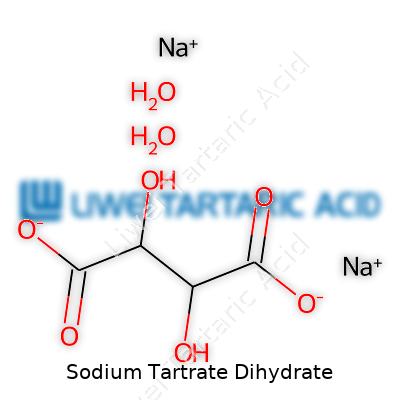
This compound’s real magic comes from its crystalline shape and the pair of water molecules tightly bound into every formula. Chemically, it looks like Na2C4H4O6•2H2O, with a molecular weight around 230 g/mol. It dissolves well in water, leaving a nearly neutral solution, which matters for precise pH-sensitive lab work. The melting point doesn’t show up until the water’s driven off, so those two water molecules matter under heat. Its optical activity stems from the tartaric acid core—a property historically used in demonstrating molecular chirality. These small details make it a preferred choice in scientific research, not just any old lab salt.
Every bottle I’ve handled from major suppliers comes with clear labeling: purity—almost always above 99%, moisture content, batch traceability, and shelf life. The lot analysis offers comfort to anyone needing accuracy, with impurity levels—like chlorides or heavy metals—spelled out transparently. Labels enforce clear hazard pictograms, even though the toxicity risks are low. All this information lands not to satisfy some regulation, but to protect users and ensure repeatability of experiments or product quality. Proper labeling bridges the gap between safety and trust, a point reinforced by decades of chemical mishap reports stemming from poor batch information.
Chemists in industrial settings prepare sodium tartrate by neutralizing tartaric acid with sodium carbonate or sodium hydroxide. This neutralization forms a solution, which they concentrate and cool to coax the dihydrate out as solid crystals. They filter, wash, and air- or oven-dry these crystals. Each step requires care in controlling heat and pH to avoid decomposition. Large-scale operations standardize temperatures and monitor for purity using quick titrations. Consistency stems from rigorous equipment maintenance—no shortcut there.
Beyond its straightforward origins, sodium tartrate’s two tartrate groups open doors to a handful of interesting reactions. Strong acids decompose it, regenerating tartaric acid—a reversible path when conditions demand. With oxidizing agents, the molecule can break down further, liberating carbon dioxide and simpler organics. Electrochemists find it useful in building complexing agents, where its chelating properties grab hold of metal ions especially well. This trait powers its use in plating baths, making it easier to control metal deposition and create even surfaces on finished goods.
A chemist searching catalogs will spot sodium tartrate dihydrate under a variety of synonyms: Rochelle salt, sodium 2,3-dihydroxybutanedioate, and E335 in food science circles. In the world of pharmaceuticals or classic qualitative analysis, these names crop up interchangeably. Documentation in different languages, regulatory listings, and supplier catalogs reflect the same reliable compound, just packaged for the end user’s context.
Handling practices mirror any high-purity compound—good gloves, dust avoidance, and prompt cleanup of spills. Its toxicity falls well below many industrial chemicals, yet repeated exposure, especially to dust, may irritate lungs or skin. Manufacturers follow GHS labeling rules and ship sodium tartrate dihydrate in sealed, moisture-proof containers. SOPs encourage storage away from acids or oxidants, safeguarding both personnel and raw material quality over long shelf lives. Anyone using the compound in food, pharma, or high-precision calibration labs leverages its published safety data sheets for peace of mind and regulatory compliance.
Walk into a titration lab, a food additive blending facility, or an electroplating tank, and sodium tartrate’s fingerprint turns up. Its sharpest usefulness comes in Karl Fischer titration, where the bound waters make it an international reference for water content determination. Food manufacturers trust it as an acidity controller—spotted by “E335” on ingredient panels. Electroplaters value it to hold together metal ion solutions, giving smoother coatings on hardware from kitchen utensils to car parts. Water treatment plants test its ability to soften water by grabbing hold of hardness ions. In chemical education, instructors prize it for hands-on demonstrations of chiral chemistry and salt crystallization.
Research teams keep finding new angles for sodium tartrate, especially in precision analysis and as a building block in coordination chemistry. Recent work focuses on pairing it with novel electrode materials, looking for more efficient batteries or greener metal extractions. Chemists use it to form organometallic complexes, unlocking new catalysts for fine chemical synthesis. Some pharmaceutical researchers probe its behavior as a carrier in slow-release medications, while a parallel track explores functional materials, tapping its stability and optical properties to make better electronics or biosensors.
For decades, toxicologists haven’t found meaningful hazards from sodium tartrate dihydrate in typical concentrations. Acute toxicity sits far above practical exposure levels. Animal studies report mild gastrointestinal irritation only at huge doses. Regulatory agencies have approved its use in food with clear limits, after long-term feeding tests showed no carcinogenic or reproductive threats. Chronic exposure data from factory workers remains reassuringly unremarkable, assuming basic hygiene rules hold. Still, researchers keep watch for potential issues involving gut flora or rare hypersensitivity, leaving open the door for better risk characterization in sensitive populations.
Sodium tartrate dihydrate’s story feels far from over. Process engineers want sharper methods that yield higher purity and lower energy usage, not just for cleaner output but for smaller environmental footprints. Electronic materials scientists have begun eyeing its stable crystal lattice for next-generation sensors and piezoelectric devices. Calibration labs across biotech and food sectors demand ever-tighter reproducibility, placing it at the center of new quality standards. Biomedical teams, meanwhile, keep exploring possibilities for chiral drug synthesis and delivery, driven by sodium tartrate’s stereoactive backbone. In the end, its interplay of low toxicity, strong performance, and easy preparation sets a high bar among workhorse laboratory reagents and opens doors for future generation breakthroughs in both classical and emerging industries.
Most people don’t spend time thinking about chemicals tucked away in food factories and science labs. Sodium tartrate dihydrate is one of those chemicals making a real difference behind closed doors. It’s present in some foods as an emulsifier, helping oil and water get along so salad dressings stay mixed and creamy instead of separating into messy layers. In the world of processed cheese, this chemical keeps the texture smooth and uncomplicated, doing its job without grabbing the spotlight. According to food safety officials in the United States and Europe, sodium tartrate dihydrate is considered safe for consumption in these small, controlled amounts.
Walk into any chemistry classroom or quality control lab, and you’re likely to find a bottle labeled sodium tartrate dihydrate. Educators rely on it for titrations, especially as a primary standard during chemical analysis. It offers a stable, reliable substance for balancing chemical equations and measuring acidity levels. These tests matter a lot in water safety, pharmaceuticals, and food production, where small measurement errors could mean big mistakes. Without chemicals like this one, keeping confidence in test results would be tough, and mistakes in public health could follow.
This chemical also finds use outside the typical lab and food plant. Some medical research taps sodium tartrate dihydrate as a reagent, helping in the preparation of other substances or as part of recipes for specialized medications. Drug manufacturers lean on the certainty and predictability it brings to their processes. Reliable chemicals keep medicines safe for patients, who deserve nothing less. The U.S. Pharmacopeia lists sodium tartrate dihydrate for use in medicine production, which shows its practical value beyond academic interest.
Many people worry about what’s in their food these days, and for good reason. Clear labeling on packaging helps shoppers make decisions that fit their health needs. European law and the U.S. FDA both recognize sodium tartrate dihydrate as safe, but only within strict limits. Efforts to keep ingredient lists readable help parents and allergy sufferers avoid unpleasant surprises at mealtime. Watching for terms like “E335” on European labels, or searching for “sodium tartrate” on U.S. packaging, makes a difference for families keeping a close eye on diet and chemical additives.
Food manufacturers and laboratory workers face pressure to choose safer, greener additives and chemicals. Research into more natural alternatives may someday speed up, but right now, sodium tartrate dihydrate takes up a spot because of its proven track record. Students and professionals should keep learning about the little molecules that still rule so many behind-the-scenes processes. Understanding why something works so well today helps the next generation tweak tomorrow’s recipes and safety protocols. That's how change grows from curiosity and care instead of quick fixes or distrust.
Experience working in both the lab and the food industry has taught me that safe, reliable chemicals form the backbone of progress. Modern life depends on them, but that does not mean accepting them blindly. Careful regulation, honest labeling, and ongoing education make sure sodium tartrate dihydrate remains a trusted tool, not a source of confusion in our lives.
Plenty of people have never heard of sodium tartrate dihydrate, but it’s lurking on ingredient lists more often than you might guess. Bakeries use it, food manufacturers sprinkle it in their mixes, and you’ll run into it if you check the contents of some packaged sweets and leavened products. Its job is pretty simple: it acts as an emulsifier or stabilizer, helping things mix smoothly and keeping textures consistent. The molecule doesn’t sound inviting, yet it’s a longstanding helper in the food industry.
As someone who watches what goes into processed food, I make it a routine to look up food additives through trusted authorities. Both the U.S. Food and Drug Administration (FDA) and the European Food Safety Authority (EFSA) have no qualms about sodium tartrate dihydrate in moderate quantities. This isn’t some loophole or misunderstanding. Science teams ran the compound through repeated safety tests. Years ago, the Joint FAO/WHO Expert Committee on Food Additives dove into data from animal studies, toxicity reviews, and real-world uses. In regular amounts, there’s not much to worry about.
It’s worth knowing that sodium tartrate is a salt of tartaric acid, found in grapes and bananas, and even appears naturally in wine barrels as those little crystals that wine drinkers find now and then. The food-grade stuff isn’t scooped out of barrels — it’s made in controlled production sites, closely monitored for purity.
Some people get anxious about food additives and that’s fair. Not every ingredient suits all bodies and lifestyles. For sodium tartrate dihydrate, researchers watch for allergic responses or digestion issues, but so far, unpleasant reactions are rare. It gets processed in the body like most salts. If you have kidney issues or a rare metabolic disorder, it’s just common sense to check with your doctor before adding any new ingredient, not just this one.
It can be tempting to lump all food additives into one scary group, but experience tells a different story. For instance, bakers rely on sodium tartrate to give certain batters the ideal lift — something you’ve probably tasted in a fluffy loaf of bread or a chewy cookie from the grocery aisle. We often don’t think twice because the results taste and look fine.
Instead of banning every unfamiliar ingredient, a smarter path is demanding clear labels. I encourage folks to read ingredients, ask questions, and check for verified sources — not fear-mongering or viral posts that twist scientific reports. Cutting processed foods is always an option, but for those who enjoy the convenience, transparency levels the playing field.
The solutions come down to informed consent. Food safety systems aren’t perfect, and there’s always a risk that the industry slides into carelessness. Consumer demand for fewer additives and more honest labeling pushes the right kind of change. Awareness, paired with action, keeps both safety and food enjoyment within reach. Keeping one eye on ingredient lists and the other on trusted research empowers shoppers to choose what’s best for themselves and their families. In the landscape of food additives, sodium tartrate dihydrate doesn’t ring alarm bells for the average healthy adult when used as intended.
Sodium tartrate dihydrate pops up in labs and classrooms across the world. Its chemical formula, Na2C4H4O6·2H2O, points to more than a set of letters and numbers. This compound supplies predictable properties, making it valuable for scientists and manufacturers. I remember mixing it with other solutions for basic titration exercises, seeing it act reliably as a primary standard without surprises or complications. Consistency should never get overlooked, especially in chemistry or medicine.
Food manufacturers depend on accurate formulas. Errors in those numbers lead to failed batches or, far worse, unsafe food supplies. Sodium tartrate dihydrate is used as a food additive and as a lab reagent. The formula ensures anyone handling or analyzing this compound knows what’s inside. Extra water molecules (that .2H2O is more than a footnote) have a real effect on measurements and how the compound behaves. Fail to account for hydration, and measurements turn inaccurate. This kind of mistake could have big consequences in drug production or standardized testing.
Good research begins with reliable building blocks. Uncertainty around a chemical’s formula throws off results, triggers failed experiments, and wastes resources. Pharmaceutical labs, food quality assurance teams, and schools trust sodium tartrate dihydrate because that formula nails down what you get. Reproducibility—one of science’s foundations—relies on this level of precision. I’ve seen labs triple-check their supplies list, all to prevent a minor mistake before running an expensive trial. Updates or corrections to a chemical’s official formula would instantly ripple through textbooks and online resources. Proper understanding prevents bigger problems down the line.
There’s a trust factor baked into how we communicate formulas. The chemical formula represents more than atomic structure; it’s a guarantee. This trust links equipment manufacturers, universities, and global supply chains. I’ve seen first-hand how mislabeling, even just a missing dihydrate tag, can send an entire project back to square one. Students get confused. Experiments fizzle. Cost overruns hit.
Clear labeling and honest communication stop problems before they start. Everyone from teachers to exporters has a duty to double-check data. Sharing knowledge about sodium tartrate dihydrate’s formula highlights why accuracy goes beyond textbooks. Digital resources and shelf labels must stay updated with the most current information. Technology offers tools to trace chemicals across supply chains and academic systems, boosting transparency. Smart tagging, regular audits, and open access databases help prevent costly errors down the road.
Sodium tartrate dihydrate’s formula, Na2C4H4O6·2H2O, carries more responsibility than it seems. It supports food safety, scientific research, and education. Learning to respect and verify these details empowers professionals to protect health, unlock discoveries, and keep daily operations running smoothly.
Sodium tartrate dihydrate steps into many labs and factories as a useful ingredient, mostly for calibrating Karl Fischer titration or lending a hand in food processes. From my experience working alongside food safety teams and lab techs, I’ve learned that the core challenge with this chemical isn’t just its performance—it's keeping it in the right shape for use. One mistake in storage, and the powder starts caking, or worse, picks up moisture and throws off any measurement or mix. That’s not something you want to discover late in an experiment or during production.
Anyone with hands-on work in chemistry knows how a single slip here can ruin an entire batch. Sodium tartrate dihydrate, as the name tips off, contains water molecules and can lose or gain moisture from the air. That means humidity turns into an unwanted guest fast. The bags or jars always deserve to sit in a dry, cool place. I’ve watched new staff leave it near sinks or on open shelves, only to find clumped material within days. Dry, sealed containers cut down this risk in a big way. Desiccators or sealed plastic bins often work best, especially in rooms where humidity swings from season to season.
Heat is rarely a friend to chemicals like sodium tartrate dihydrate. Routine exposure to sunbeams or a warm corner behind the furnace shortens its useful life. Refrigeration might seem smart, but unless you’re running a climate-controlled cold room, condensation messes things up more. Controlled room temperatures—say between 15°C and 25°C—offer a safe range in most labs or food processing spots. No need to overthink this—keep it away from direct sunlight and heat sources, and stick to shelving that doesn’t wobble with temperature jumps.
Old habits like using any spare jar can lead to serious confusion and even cross-contamination. A co-worker once repackaged sodium tartrate dihydrate in a used salt container, which almost landed in the wrong tank. Plain, sturdy containers with clear labels steer clear of that headache. Dates matter, too; writing down when a container opened or arrived means nobody touches stale or possibly degraded powder.
Working with inspection authorities opened my eyes to the mess that careless storage can spur. In the U.S., the Food and Drug Administration (FDA) and Occupational Safety and Health Administration (OSHA) both stress clear chemical labeling and adequate control over shelf life. Sodium tartrate dihydrate doesn’t top the hazard charts, but it can lose calibration accuracy fast if it gets damp or dirty. Keeping an inventory log closes the loop, so you know what to restock or throw out.
Make storage protocols a team habit, not just a chore for managers. Easy-to-spot bins, a good desiccant pack inside, and a shaded, dry storeroom do most of the heavy lifting. Get rid of leftovers as soon as caking or unexpected color shows up. Routine cleaning pays off—chemicals like sodium tartrate dihydrate last longer and perform better without dust or debris. In the end, safe storage doesn’t require fancy tools—just steady discipline, sharp eyes, and respect for the small print on each label.
Baking soda gets all the attention in grandma’s kitchen, but sodium tartrate dihydrate plays a less glamorous yet just as crucial part in commercial food production. Anyone who reads ingredient lists on baked goods or processed cheese might spot “E335.” That’s sodium tartrate. Industrial bakeries add it to maintain texture and stabilize the dough, making sure every batch comes out as intended. Cheese makers rely on it, too, to improve moisture retention and create a creamy consistency that doesn't break down during packaging or storage.
Food safety hinges on reliability and traceability, especially where production lines run all day. Sodium tartrate dihydrate makes cheap, accurate calibration of Karl Fischer moisture analysis feasible. This analysis pins down tiny traces of water in foods, oils, or pharmaceuticals. If the lab water readings drift, the results mean nothing—causing either spoilage or wasted product. Because sodium tartrate dihydrate contains a known, reliable percentage of water, it’s the stick in the ground against which labs measure every test. Fewer recalls, better shelf life, less food wasted.
Medications only work if every dose behaves exactly as expected. Pharmaceutical manufacturers lean on sodium tartrate dihydrate for its stability, using it as a buffering agent in tablet formulations. Its predictable properties help prolong shelf life and increase effectiveness. I’ve seen industry colleagues breathe easier while passing regulatory audits—they can point directly to the use of sodium tartrate standards in their moisture content testing, which underpins quality checks throughout large-scale drug production.
It’s not just about standards. This compound steps in as a stabilizer for certain liquid drugs, where it reduces the risk of active ingredients breaking down before a vial even reaches patients. Those stability benefits mean fewer batch failures, helping companies ensure that medicine in rural clinics or city hospitals retains its power where it matters most.
Industrial labs—big and small—depend on sodium tartrate dihydrate for analytical chemistry, especially in titration experiments. It shows up as a reducing agent for processes that require a gentle but reliable hand, such as determining the concentration of iron or copper in water samples. Whether pulled from a warehouse shelf in tons or measured out by the gram, the stuff delivers consistent, transparent results. These small steps support broader water safety and environmental monitoring programs.
Water utilities conduct daily quality tests before sending water through the tap. Sodium tartrate dihydrate acts as a reference material, giving technicians a dependable means to check their equipment. This reliability helps catch contamination threats early—before people ever see discoloration or taste a problem. Labs in mining or agriculture also use tartrates to calibrate their moisture meters, helping with soil quality assessments and environmental remediation efforts.
As industries push for greener, safer ingredients, the supply chain for sodium tartrate dihydrate could benefit from more transparency. Companies investing in sustainable sourcing—like using less energy or drawing from waste-free raw material streams—can keep costs competitive and win trust. Some manufacturers, especially in emerging markets, might need education and support to maintain purity and documentation standards. Practices like better tracking, more open audits, and digital record keeping can move the industry from baseline compliance to truly dependable quality.

Providing high-quality chemical products and logistics solutions for global trade partners.



