
DL-tartaric acid stands as a product of both chance discovery and persistent effort. Early wine-makers noticed crystals forming in their casks long before scientists understood their significance. In the late 18th century, researchers isolated tartaric acid, and over time chemists learned to identify and separate its optical isomers—dextro, levo, and the racemic mixture we call DL-tartaric acid. In the industrial era, the race for synthetic chemistry techniques pushed development forward. Each advancement supported new uses across several industries, leading to consistent demand and ongoing production improvements. Throughout its journey, DL-tartaric acid reflects a broader story: innovations often unfold through patient refinement, not sudden breakthroughs.
Some compounds end up everywhere in daily life, and DL-tartaric acid wears that badge with no sign of slowing down. This synthetic version, featuring equal parts left and right-handed molecules, has carved out a place in numerous commercial sectors. From food flavoring and stabilization to construction additives, this acid continues to prove useful. Companies choose the DL form to balance effectiveness with manufacturing costs, especially where the specific handedness of the molecule doesn’t affect functionality. By bridging gaps between affordability and versatility, it becomes an unglamorous but essential player in many systems.
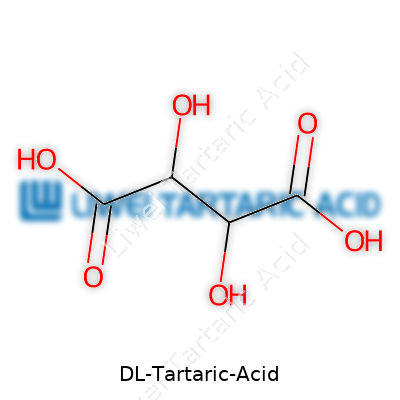
DL-tartaric acid comes across as an odorless, crystalline solid with a sharp, acidic taste. This powder draws water easily, making it hygroscopic. The compound melts at just over 200°C and dissolves readily in water, giving it access to numerous formulations. Molecular weight sits at 150.09 g/mol, and its structure ensures two carboxyl groups can both donate protons, granting it strong acidic properties. In practice, this means DL-tartaric acid can change the pH of a solution rapidly and reliably. By comparing its solubility with similar acids, formulators often select DL-tartaric acid when they need sharp acidity combined with solid handling characteristics.
Looking at any reputable manufacturer's datasheet, specifications for DL-tartaric acid run detailed. Purity levels typically target 99% or above, with strict controls for contaminants like heavy metals—arsenic and lead must sit far below regulatory thresholds. Loss on drying remains crucial too, since moisture affects flow and reactivity. Common labeling requirements point out batch numbers, production dates, shelf life, and country of origin. Food-grade products must list compliance with authorities such as the US FDA or the EU E-number system (E334 for tartaric acid). Regulatory transparency fosters both trust and traceability, which becomes central during product recalls or regulatory changes.
Production starts with by-products from the wine industry, notably crude potassium hydrogen tartrate, or “wine stone.” Chemical treatment with lime and sulfuric acid releases the acid form before further purification. To achieve the racemic DL mixture, chemists blend equimolar quantities of natural (L) and synthetic (D) forms, or use methods that generate both simultaneously from petrochemical sources. Advances in chemical synthesis have made large-scale, low-cost production feasible. Over the past few decades, factories introduced automation and digital monitoring to maintain purity and consistent particle size. This constant evolution keeps the price stable for such a widespread compound.
DL-tartaric acid participates in a variety of classic reactions. It can esterify with alcohols, creating tartaric esters used as plasticizers or emulsifiers. Direct reactions with bases form tartaric salts, some with unique physical properties that suit niche industrial uses. Oxidation reactions produce compounds like dihydroxyfumaric acid, which opens the door to even more applications. Where tailored properties become important, chemists tweak substituents on the tartaric backbone, showing that a classic molecule still leaves room for innovation at the intersection of tradition and contemporary science.
Across the world, this acid may appear under several monikers: racemic tartaric acid, DL-2,3-dihydroxybutanedioic acid, and E334 in food labeling. Some suppliers name it based on purity or source (“synthetic tartaric acid, DL grade”), while others distinguish it by geometric specifics. These terms avoid confusion, especially in industries where one isomer makes sense but the racemate fits better elsewhere. End-users who learn these synonyms navigate sourcing and regulatory paperwork with fewer hiccups, avoiding misapplication and compliance errors.
DL-tartaric acid does require common sense handling. Inhalation of dust causes irritation, and prolonged skin contact draws complaints of redness or dryness. Safety data sheets recommend gloves and protective eyewear. Regulatory bodies like OSHA and the EU CLP assign its hazard classes based on acute oral toxicity—very high doses, far beyond anything encountered in processed foods, may present real risks but casual exposure stays low-impact. Facilities enforce proper ventilation and emergency eyewash stations to head off rare incidents. All containers get labeled with safety instructions, traceability codes, and hazard pictograms to support no-nonsense compliance in fast-paced environments.
This acid’s reach stretches much farther than most folks guess. Food processors mix DL-tartaric acid into jams, candies, and carbonated drinks for its punchy flavor and its knack for stabilizing color and shelf life. Pharmaceuticals rely on it as an excipient—balancing the pH of tablets or acting as a chiral agent in drug synthesis. Construction chemists blend it into cement and plaster mixes, controlling hardening times. Textile finishing and metal cleaning both use tartaric acid solutions to adjust acidity or precipitate impurities. Winemakers keep it around to tweak acidity after fermentation. Its multi-industry presence proves value springs more from adaptability than raw novelty.
R&D around DL-tartaric acid has picked up, especially with green chemistry and sustainability goals. Investigators are exploring biotech-based routes that recycle agricultural waste or engineer microbes to produce tartaric acid with lower energy consumption. New applications grow from advances in nanotechnology—scientists use tartaric acid in templating nanoparticles or as a scaffold for new synthesis reactions. Material science groups experiment with functionalized versions to create smart coatings or responsive polymers. Each new project seems to hinge on a simple truth: Old chemicals don’t become obsolete, they keep finding new reasons to exist.
Toxicologists keep a close eye on DL-tartaric acid, given its inclusion in foods and drugs. Data shows it breaks down quickly in the body and gets excreted in urine, so it doesn’t linger to cause harm at typical exposure levels. The U.S. FDA’s Generally Recognized As Safe (GRAS) status depends on this well-documented metabolization. Animal studies suggest high doses can disrupt electrolyte balance and kidney function, but everyday usage in food or pharma stays many steps below risky thresholds. Vigilance continues as new consumption patterns—or new blends with other chemicals—push the boundaries of traditional toxicology. By staying ahead with regular reviews and new testing, public health protections keep up with evolving industry practices.
With chemical manufacturing institutions steering toward sustainability, DL-tartaric acid’s production pathway stands ready for significant upgrades. Bio-refineries might replace petrochemical plants, and green solvents could shrink environmental footprints. As global industries demand more transparent sourcing and lower-impact ingredients, traceability and eco-labeling will become the norm. Emerging tech in pharmaceuticals and nanomaterials will likely boost the need for precise, high-purity grades. As old infrastructure yields to automated, digital-first factories, the experienced hands running today’s production lines will find new roles in quality assurance and continuous improvement. The acid may never leave headlines as a cutting-edge molecule, but its steady hand will guide many products for decades ahead—providing quiet consistency in a world chasing the next best thing.
DL-tartaric acid doesn’t grab headlines, but its fingerprints show up on everything from soft drinks to building sites. I’ve seen it blend into countless products. During my time working kitchen shifts, I came across it on food labels, but few pause to ask why it keeps turning up. Tossing aside the technical jargon, let’s look at where it ends up and why it deserves attention.
Take a stroll through any supermarket. DL-tartaric acid sneaks its way into fruit juices, fizzy drinks, candies, and baking powders. Its main job? Sharpen up flavors and tweak sourness. A lemonade without it can taste flat. Some tartness in sweets and soft drinks feels just right to our taste buds. This acid balances sweetness, keeping products from getting cloying. In wine production, DL-tartaric acid clears haze and brings a fresh zing that wine lovers chase. Anyone who’s worked with grape harvests sees bags of it lined up next to barrels. Without these crystals, many commercial wines wouldn’t last as long on the shelf or taste as crisp.
It doesn’t stop with drinks. I learned early on that baking powder relies on a careful mix of ingredients, and tartaric acid sets off the fizz with sodium bicarbonate. Cakes and cookies rise because of this simple reaction. Fast food outlets and bakeries favor it because it performs consistently and holds up under different storage conditions. Most customers never spot it on an ingredient list, but every baker cares about how that carbonation turns flour into something pillowy.
Pharmacies and labs tap into DL-tartaric acid as well. Its role isn’t fluffy: it stabilizes drug formulas and adjusts the pH of medicines for safe consumption. Without getting technical, having the right pH can affect whether a pill works as promised. Pharma companies count on its stability and predictable behavior. In chewable vitamins, it softens chalky flavors. I've personally noticed how vitamins without it can taste bitter and are hard to finish.
Walk through any construction site or factory, and DL-tartaric acid pops up again. Cement manufacturers add it to slow down setting times. In summer, concrete can harden too quickly, leading to cracks. I once watched a builder sprinkle the powder into a concrete mixer to save a sidewalk pour during a sweltering afternoon. It’s rarely discussed, but this little fix saves time and money—and keeps structures standing a lot longer.
Most folks don’t spend much time thinking about these hidden helpers, but there’s a reason to pay attention. Regulations need to keep up with demand, making sure DL-tartaric acid comes from reliable sources. Putting more effort into food-grade standards and better labeling can reassure families and businesses alike. There’s also interest in sourcing it from renewable berries or grapes, not just chemical factories, cutting down on waste and boosting transparency. People should know what they’re eating or using at work. Stronger supply chains with third-party testing can back that up.
DL-tartaric acid earns its place by helping foods taste better, medicines perform safely, and buildings last longer. Instead of flying under the radar, its everyday usefulness should make us look twice at ingredient lists and industry labels. A bit of awareness and smarter oversight would only add to the value it brings to our lives.
Tartaric acid shows up in the kitchen and in commercial food recipes, especially in baking powder, soft drinks, and candies. The natural form—L-tartaric acid—comes from grapes and various fruits. DL-tartaric acid is a lab-made version containing both the natural and synthetic forms. It acts as an acidulant and stabilizer, giving products a sour punch and helping keep them shelf-stable. Most of us unknowingly eat small amounts, especially if we love grape juice, fruit-flavored snacks, or fizzy drinks.
DL-tartaric acid pops up on the list of approved food additives. This isn’t just some stamp handed out by a bored official—it comes after toxicology reviews. The U.S. Food and Drug Administration lists tartaric acid as “Generally Recognized as Safe” (GRAS) for its intended uses. The European Food Safety Authority and World Health Organization also green-light its use in set amounts.
Researchers kept a close eye on how much of this acid our bodies handle. Studies point out that in normal quantities, our bodies can break it down and get rid of it. Too much, though, and it can irritate the stomach, like many other acids. There have been rare case reports of people getting sick from unusually high doses, leading to nausea or cramps.
Plenty of folks I know grab a drink or eat a gummy without thinking about the ingredient list. We expect regulators and scientists to watch our backs. Over the years, the use of DL-tartaric acid hasn’t set off red flags like some other additives. I’ve never met a friend or family member who pointed to this acid as the reason behind a food allergy or upset stomach. If anything, folks are more likely to react to food dyes or preservatives.
Still, I’ve noticed people eating more processed food than before, which means more overall exposure to food additives, even the less controversial ones. If someone already has a sensitive stomach, or deals with conditions like acid reflux, cutting down on very acidic foods, including those with tartaric acid, makes sense.
Food producers test different types of acids, looking for ones that add taste and extend shelf life without crossing safety lines. Strict food safety standards make sure levels of DL-tartaric acid stay far below the amount that caused problems in clinical studies. For example, the World Health Organization states an “Acceptable Daily Intake” of up to 30 mg per kilogram of body weight.
Consumers can also check labels. While ingredients may not stand out, an allergy or digestive issue makes it worth reading the fine print. At home, people can swap out highly processed snacks for fresh fruits, nuts, or simple whole grain crackers to easily cut back on many additives—including DL-tartaric acid.
It helps to pay attention to how our bodies feel after eating certain foods, rather than just trusting every label. If a certain product repeatedly causes trouble, it might be time to look closer at the ingredients or talk with a dietitian. Authorities keep an eye on additives and re-evaluate their safety as new research emerges. Ingredient safety never stands still; advances in science push updates and, at times, lead to stricter regulations.
Growing up in a family that made wine in the garage, tartaric acid came up more than you might think. The white crystals at the bottom of my dad’s wine bottles looked harmless, but talk to anyone pressing grapes in the kitchen and you’ll hear quick advice: don’t confuse one tartaric acid for another. That’s where the real-world difference between DL-tartaric acid and L-tartaric acid comes in.
Both forms might look the same in a jar, but the letters “D” and “L” stand for something real. L-tartaric acid shows up in nature—think grapes, bananas, and even tamarinds. It’s what you pull out when you want to acidify food safely. Factories making grape juice or processed sweets rely on L-tartaric acid because bodies know what to do with it. The human digestive system handles L-tartaric acid without trouble, breaking it down efficiently.
On the other hand, DL-tartaric acid is made in labs. It’s a 50-50 mix of two mirror images (D and L forms). Flip one around, and it looks like the other, but chemically, your body doesn’t process both sides the same. That mirrored D-half barely gets metabolized. In real-life terms, choosing DL-tartaric acid for food or drink changes more than taste. Regulatory rules in the US and Europe limit DL-tartaric acid for anything meant to be swallowed. L-tartaric acid earns its place on labels after a lot of safety checks.
For anyone quilting a wedding cake or fermenting wine, L-tartaric acid makes things bright and tart. It keeps color and flavor stable over weeks on the counter. Pharmaceutical companies use it to mix up pills, relying on what’s familiar to the body. Walk into a sports shop and you’ll spot it in drink powders.
Lab-made DL-tartaric acid doesn’t show up on as many kitchen shelves. Industries lean on it for making construction materials, some chemical processes, and textile stuff. It works, but its safety record falls short in food settings. That L piece acts just like its natural cousin, but the D component lingers in the body, sometimes causing stomach upset. Regulatory agencies push manufacturers to stick with L-tartaric acid for anything that goes in the mouth.
There’s a reason for these strict boundaries. Research dating to the twentieth century shows humans break down L-tartaric acid using regular enzymes in the gut, while the D-form either passes through or causes trouble. For people sensitive to additives, even a little of the wrong tartaric acid can disrupt digestion.
Public health agencies, including the FDA and European Food Safety Authority, record data from centuries of tartaric acid use. L-tartaric acid continues to show a strong record of safety. Cheap mass-produced DL-tartaric acid slips into cleaning agents and industrial products, not salads or wines.
Anyone using tartaric acid at home needs to check product labels. Stick with L-tartaric acid for cooking or winemaking. Ask suppliers for sourcing information, and turn to reputable sellers with transparent labeling. Testing agencies and regulatory watchdogs carry out regular spot checks, but consumers hold the last line of defense by knowing the difference. Choosing the right tartaric acid makes food safer and supports a tradition that runs from backyard vineyards to bustling candy factories.
DL-tartaric acid has a reputation bigger than its name. Most folks outside of R&D labs don’t give it much thought, but ask anyone stocking up for a food production line or prepping an industrial cleaner—supplies matter, and ingredients like this show up all over the map. As someone who’s handled ingredient research in bulk procurement, I’ve seen the broad reach of this simple acid. Companies looking to hit the right taste, texture, or chemical reaction pull it out of the toolkit again and again.
Walk down a grocery aisle and you’ll see tart taste everywhere. Food manufacturers depend on DL-tartaric acid to wake up flavors in candy, baked goods, and carbonated drinks. You’ll find it stabilizing egg whites in meringues, holding colors bright in jams, or acting as a pH controller in processed cheese. A little bit of acid puts the “snap” in sweet treats and keeps things shelf-stable a lot longer than nature would allow on its own. Data from market research firms like Grand View Research backs up tartaric acid's hold over the food and beverage sector: value is measured in the hundreds of millions.
People don’t want fillers in their medicine unless that filler actually does its job. In pharmaceuticals, DL-tartaric acid provides more than just tartness—its presence can affect how quickly medicines break down, how well they’re absorbed, and even their taste if a chewable tablet is the goal. As a chiral resolving agent, this acid helps drug manufacturers separate out the usable forms of active compounds. Companies in the sector lean on tartaric acid whenever purity counts, or if a buffering effect is needed to make a pill stable on the pharmacy shelf.
Tartaric acid isn’t just the backbone of candy or cough syrup. Stone and tile cleaning, metal finishing, and textile processing all use DL-tartaric acid for its ability to chelate metals and clean surfaces. I once worked with a facility that needed a bulk acid solution to keep limescale out of processing equipment. Tartaric acid brought enough muscle to dissolve mineral buildup without damaging critical equipment. That’s why industrial blending solutions keep it in rotation—strong enough to do the job, mild enough so that workers can handle it safely, unlike harsher, more aggressive acids.
The wine industry gave the world tartrate crystals long before the rest of us caught on. Tartaric acid controls pH in wine and determines the final balance of flavor, mouthfeel, and shelf life. Small wineries and giants alike monitor its presence every season. Grapes deliver plenty naturally, yet every bottler checks and tweaks the final levels before corking up a new vintage. This means even handcrafted operations rely on tested standards that have been shaped by DL-tartaric acid’s unique chemistry.
Food safety watchdogs, health authorities, and industrial buyers all shape the future path for tartaric acid. Concerns about counterfeit additives and purity put extra pressure on quality control. As the market expands, responsible sourcing and tighter regulatory controls matter more than ever. Setting clear supplier audits and tighter traceability lets companies avoid poor quality acid that could spoil products or put public health at risk. In the end, DL-tartaric acid’s reach depends on trust as much as on chemistry.
DL-tartaric acid looks simple on paper. White crystals, goes into food and pharma, shows up in labs regularly. People use it for everything from balancing wine flavor to making industrial chemicals. It seems straightforward, but I’ve seen what poor storage can do. Even with a modest bag or drum, give moisture and light just a little too much room and things go south fast.
As someone who’s worked in a facility where acids sat in the corner, unlabeled or only half sealed, I can tell you: safe storage moves from “nice to have” to “forgot to do, now ruined.” Mold sets in, caking starts. Sometimes the stuff clumps into hard masses or granules dissolve. Forget hoping for accurate measurement or safe handling after that. So I care about people doing it right, and not just because regulatory audits make life stressful.
Humidity is DL-tartaric acid’s most persistent enemy. Once the crystals pull moisture from the air, they lose their clean, free-flowing quality. Left open in a humid room, the acid picks up water, forms lumps, and you end up fighting with the bag to scoop clean powder. Put it in a sealed, airtight container. Thick plastic bottles with tight-fitting lids work well, or lined drums for larger amounts. Close the lid tightly every time—even if you think it’ll only be a few minutes before the next use. Take it from someone who ruined an entire batch for a project because I thought “I’ll get back to it after lunch” didn’t matter.
Consistent, cool storage slows down breakdown. Extreme heat changes how crystals behave, especially in warehouses with poor ventilation. I remember a shipment that spent too long in a summer loading dock; we had yellowing and odd odors. Temperatures between 15°C and 25°C (59°F to 77°F) keep DL-tartaric acid stable. If you store materials near heat sources or windows, relocate them. Shaded shelving or a dedicated cool room can pay for itself when you look at lost batches and contamination clean-up.
Open-air storage also pulls in airborne dust, insects, and cross-contamination from other chemicals. You don’t want to risk DL-tartaric acid coming in contact with strong oxidizers, alkalis, or organic material—discoloration and unpredictable reactions can follow. Clear labeling matters. Storage containers should tell anyone at a glance what’s inside and when it arrived. Outdated stock does no one any favors; rotate older lots forward and use “first in, first out” practices to cut down on spoilage.
Not everyone runs a perfect lab or factory. Even a small bakery with a single shelf can handle this well with the right choices. Simple dry cabinets or designated bins, placed away from sinks and cleaning supplies, work for small spaces. Always check packaging after delivery too; any tears or punctures spell trouble. Workers need regular reminders—in the breakroom, or on the wall by storage shelves. In my experience, it only takes one person leaving a bag open for a whole team to lose trust in their source.
DL-tartaric acid rewards careful treatment. Keep it dry, cool, sealed, and clearly labeled. Check supplies often and remind everyone why sloppy storage costs real money and safety. With some practical steps, trouble never has a reason to start.

Providing high-quality chemical products and logistics solutions for global trade partners.



