
Chemistry has always moved forward with a push from necessity and curiosity, and Dipropylene Glycol Dibenzoate (DPGDB) follows that same story. For decades, manufacturers sought alternatives to traditional phthalate plasticizers after health and regulatory targets started raising red flags. DPGDB entered industrial landscapes in the late 20th century as a solution crafted to answer those calls for safer and more efficient performance. Its development built on the foundation of glycols and benzoic acids, substances long trusted in synthetic chemistry. Production scaled up as restrictions tightened on older plasticizers, and DPGDB’s lower toxicity gave businesses a way to adapt to tighter rules without sacrificing performance in products like adhesives, flooring, and synthetic leathers. My experience working alongside chemical engineers tacking onto old processes with new ingredients gave me a firsthand look at that kind of adaptation. Often, the story in the lab mirrored the changing face of chemical safety worldwide, as regulations began to shape not just what could be made, but how the public viewed everyday household goods.
DPGDB tags along as a liquid plasticizer. It shows its value most in vinyl flooring, wall coverings, and pressure-sensitive adhesives, but it has a way of turning up in sealants, plastisols, and some coatings too. Its rise in use always linked back to its low volatility, stable shelf life, and compatibility with a wide range of polymers—especially polyvinyl chloride (PVC) and its cousins. As more markets started turning down phthalates, DPGDB filled the void with a profile that could meet both technical demands and regulatory burdens. A lot of my colleagues in materials research pointed out that the shift wasn't about finding one perfect substitute, but about finding something that did the job well enough to keep the supply lines moving and doors open.
DPGDB comes as a clear, oily liquid. The typical commercial batch weights in with a specific gravity hovering between 1.13 and 1.14 g/cm³ at room temperature. Viscosity sits solidly in the range of 85 to 95 mPa·s when measured at 25°C. It barely has a smell—an important point for anyone handling material day in, day out. Boiling point sits high, usually above 370°C, which tells you it hangs tight in plastic and rubber under processing temperatures. It won’t dissolve in water thanks to its hydrophobic, double-benzoylated backbone but does mix well with common organic solvents and many liquid resins. Stability under normal storage conditions rarely causes a fuss, so it sits well on the shelf until needed. These characteristics all feed into why so many R&D labs decided to press this molecule into service.
Anyone sourcing DPGDB for industrial blending takes a close look at purity, acid number, color, and water content. Commercial standards often require purity upwards of 98%, with acid value kept below 0.1 mg KOH/g. Color—usually checked with the APHA scale—must remain low to prevent discoloration of end products, with numbers not exceeding 80. Water content clocking in under 0.1% makes a real difference; excess moisture can throw a wrench in certain polymerization reactions. Labels call out UN numbers for transportation, signal phrases about skin and eye contact, and details tied to the European REACH registration. In my experience, the best-run plants never cut corners on labeling. If someone can’t reach for a drum and see exactly what’s inside or what hazards to expect, the risk for missteps goes up fast.
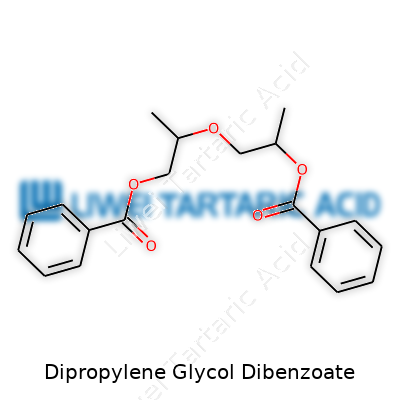
Crafting DPGDB relies on reacting dipropylene glycol with benzoic acid in an esterification step, usually catalyzed by strong acids like sulfuric acid or para-toluenesulfonic acid. This process distills off water—sometimes under vacuum or a stream of nitrogen—to drive the equilibrium toward the finished product. Careful control of temperature, stoichiometry, and purification makes all the difference between a clean batch and a run that needs reworking. Having stood beside operators mid-shift as they monitored distillation columns, it’s clear that small shifts in feed quality or heating rates can dangle the whole outcome on a knife-edge.
Once made, DPGDB resists most reactions under typical storage or use. The ester groups provide chemical resilience against bases and acids under most conditions. Yet under strong hydrolysis, those linkages can snap, reversing the original reaction and liberating dipropylene glycol and benzoic acid. Few real-world applications push DPGDB that far, but process upsets or improper blending with highly reactive agents can make it degrade. Some R&D work aims at building DPGDB derivatives with modified end-groups to tune solubility or reactivity for niche uses. Based on bench-top experiments I saw at trade shows, pushing those modifications to a commercial scale takes a rare mix of chemical know-how and plain-old grit.
In paperwork or purchasing lists, DPGDB pops up under a range of product names. Dipropylene glycol dibenzoate is the standard, but you’ll see trade names like Benzoflex 9-88 or Palatinol DPG in supplier catalogs. IUPAC tags it as 2,2'-[Oxybis(2,1-ethanediyloxy)]di(ethyl benzoate), though most folks in production lines stick to the shorter common names. Having clear documentation about synonyms avoids cross-ups, especially now that REACH and OSHA both eye supply chains closely for data transparency.
Every chemical brings its own stack of safety concerns. For DPGDB, exposure routes focus most on skin and eye contact, since accidental ingestion isn’t a risk in tightly run operations. Handling guidelines call for gloves, goggles, and in cases of regular contact, splash aprons. Large-scale facilities invest in local exhaust and good general ventilation to cut down the small vapor that does escape during blending or heating. Spill response usually involves absorptive materials, not water sprays, since the liquid floats and spreads. Safety Data Sheets, regularly updated as new findings drift in, remind everyone about long-term chronic exposure targets—even though acute toxicity sits on the mild end by historical standards. Audits focus as much on process containment and training as they do on paperwork, which fits my experience in hazardous materials control.
DPGDB gets added to adhesives, sealants, vinyl tiles, and water-based coatings. It softens polymers and boosts resistance to wear and tear, making products last longer under daily stress. In shoe soles, you'll notice its touch in how flexible yet durable the finished material feels. Adhesive manufacturers use it to dial in that sweet spot between bond strength and easy application. In modern flooring, DPGDB helps keep surfaces tough but forgiving underfoot—a balance every homeowner notices, even if they never see the ingredient list. Customers started expecting safer, longer-lasting products as awareness of plasticizer effects spread, and DPGDB grew to match that expectation. The diversity of uses points to a future where additives must wear many hats—balancing regulatory needs, safety, and practical performance.
Ongoing research looks at how well DPGDB lines up with new eco-label requirements and how it interacts with emerging polymers, especially bio-based plastics. Some scientists push its blends further, seeking ways to lower migration out of flexible PVC into food packaging or soils. Universities and corporate labs run aging tests, mechanical strength trials, and migration studies—a level of scrutiny that older chemicals side-stepped in their early days. In group meetings, researchers swap notes on unexpected outcomes—sometimes a batch that fared better out in humid conditions, or a recipe that cut emissions from processing plants. Cross-disciplinary projects pick up steam, blending chemistry, toxicology, and supply chain impacts all at once.
DPGDB scores below many older plasticizers on metrics like acute oral toxicity and skin irritation, though long-term exposure data continues to expand. Chronic studies in rodents hint at a lack of carcinogenicity, and workplace health investigations so far report no big jumps in respiratory or skin allergies versus the general population. Regulators rate DPGDB as a low-concern plasticizer on most continents, provided control measures in handling remain sharp. Still, labs in Europe and Asia run ongoing work with environmental fate and bioaccumulation studies, since nothing in chemicals happens in isolation. Early results point away from significant hormone-disrupting effects, but calls for expanded generational studies echo through scientific roundtables. From my view, transparent toxicology makes the difference for community trust and wise adoption.
The push for non-phthalate solutions moves the spotlight toward DPGDB and similar compounds. Manufacturers and regulators want products that balance safety, flexibility, and affordability. Innovation leans on new methods to improve compatibility with tough plastics or to reinforce its resistance to leaching and weathering. The rising popularity of green chemistry challenges researchers to tweak the production process with renewable benzoic acid and dipropylene glycol derived from waste biomass—steps that cut down on carbon footprint. Consumer interest runs high, too. Transparent labeling and third-party certifications started acting as selling points, not afterthoughts. As supply chains globalize, keeping DPGDB standards consistent across regions matters more than ever, and companies invest in audits and supplier education so buyers from Shanghai to Santiago get equivalent material. My time spent in both small-batch labs and on busy factory floors made it clear that the future belongs to materials that can keep both performance and public reassurance balanced—something DPGDB is steadily earning a reputation for.
Walk into any store with vinyl floors or try sticking two surfaces together, and you might bump into work done by dipropylene glycol dibenzoate. I first heard about it while helping my neighbor renovate his kitchen, wondering why vinyl tiles never seemed as brittle as old records. Turns out, this chemical keeps materials like PVC in flexible shape much longer than you’d expect.
Flooring manufacturers depend on this compound for soft and workable vinyl tiles and sheeting. Without something to keep things flexible, you’d probably chip or crack floors from basic daily living. Many adhesives—those glues that actually hold under pressure and don’t dry out overnight—point to dipropylene glycol dibenzoate as a key part of their recipe. It acts, very simply, as a plasticizer, making brittle materials bend and hold instead.
Most people rarely notice what keeps their floors flat, or how their seals in caulk stay put when the weather turns. One thing researchers stress involves safety, especially if you have pets or kids roaming around. Dipropylene glycol dibenzoate passes routine safety evaluations and doesn’t release toxins in common household uses. That means once those vinyl floors are down, nobody worries about fumes or surface dust causing trouble. Regulatory bodies like the European Chemicals Agency have scrutinized it for years, and you’ll find it on lists of approved substances for situations where indoor safety matters.
Many people reach for greener products now, and for good reason. This compound draws less attention compared to phthalates, which raised health concerns years ago. Dipropylene glycol dibenzoate offers lower toxicity and fewer worries about long-term buildup in people or the environment. Even in industrial settings, workers spend less time monitoring harmful exposure compared to some older alternatives.
Eco-certification groups look for ingredients that break down without building up in water or soil. From what I’ve read digging through green chemistry journals, this additive fares well after breakdown and doesn’t cause problems in normal wastewater treatment plants. Companies can point to it as a sign they’re paying attention to both end users and the planet.
If you’ve ever tried caulking a tub or gluing down a tricky bit of flooring, you know results matter. I’ve used plenty of products promising flexibility, only to end up with cracks and cold drafts. Formulators pick dipropylene glycol dibenzoate because it brings a strong mix of performance and value. It doesn’t just soften plastics; it helps glues set at the right speed, which saves professionals and DIYers loads of frustration.
As architects and contractors chase longer-lasting, safer building materials, this compound sits in the middle of those improvements. Without the right additives, industries would fall back on brittle sheets, short-lived adhesives, and riskier ingredients. Dipropylene glycol dibenzoate keeps manufacturing practical, affordable, and focused on the real-world needs of users.
Looking on the back of a favorite lotion, the ingredients read like a foreign language. Dipropylene Glycol Dibenzoate (DPGDB) might pop up. This chemical comes from the glycol and benzoate families. Scientists use it as a plasticizer to keep products smooth and flexible. Brands choose it to help other substances in makeup and haircare work together, and to improve texture.
Safety matters for anything rubbed, sprayed, or smeared on skin. The Skin Deep® database from the Environmental Working Group lists DPGDB with a low to moderate hazard rating, depending on exposure and concentration. Studies available so far point to low toxicity. Skin irritation and allergic reactions appear rare in reports from those who use cosmetics with this ingredient. The Cosmetic Ingredient Review (CIR) Expert Panel reviewed safety data on glycols and found similar chemicals cause little trouble in normal use.
The European Union still allows DPGDB in personal care products, but keeps watch through regular reviews. Japanese and US authorities have not flagged significant risks so far. In labs, animals exposed to high doses for long periods did not show strong effects that would scare people away from casual daily use. If regulators start finding new risks, rules can change quickly.
Putting trust in labels isn’t always easy. My own skin acts up to many perfumes and dyes. I search out ingredient facts, especially for chemicals not everyone has heard of. In my research, I found that people with extra-sensitive skin should always patch test new products, even if the label lists “safe” ingredients. Reviews on beauty forums back this up — most people do fine with DPGDB, but some get mild itching or redness. Rarely, someone breaks out or develops contact dermatitis. Those cases tend to involve higher concentrations, or mixing with heavy fragrance or other irritants.
Cosmetics and skincare make up a crowded and sometimes confusing market. Consumers want smoother skin or shinier hair, but not at the cost of health. Too many chemicals sound harmless, but build up over years of use. Safe today does not always mean safe forever. Scientists have uncovered dangers hiding in everyday products before.
Transparency from brands helps everyone make smarter choices. Companies should share lab results and respond quickly if new safety evidence appears. Ingredient lists need to be clear and readable by more than chemists.
More long-term studies on DPGDB and its cousins would help. Government and independent watchdogs like the EWG keep an eye on the latest science. Dermatologists urge people with sensitive skin to use basic moisturizers and avoid products with long lists of unfamiliar substances, especially if they have histories of allergies or eczema.
Patch testing stands out as the easiest way to spot a problem before it spreads. Shoppers with concerns about DPGDB can look for alternatives labeled “fragrance-free” or “for sensitive skin,” which often skip unnecessary additives. Taking pictures of ingredient lists and researching them with trusted health sites can help cut through advertising hype.
In the end, DPGDB remains just one piece of a much bigger safety puzzle. Responsibility falls on brands, scientists, and shoppers to keep asking questions and demanding better answers.
Dipropylene glycol dibenzoate often finds attention in manufacturing circles, especially for folks working with flexible plastics, paints, and adhesives. It works as a plasticizer, which means it helps hard materials soften up and bend without cracking. That change isn’t just about comfort or appearance—softer materials can take a beating, last longer, and feel better to touch. In my early production job mixing polymers, this liquid made our batches easier to handle, which sped up the line and led to better quality checks.
This compound looks like a colorless or pale yellow liquid with a light, sometimes sweet smell. It pours without fuss, doesn’t thicken up quickly like some other plasticizers, and blends quickly into compounds at room temperature. At around 340°F (170°C), it starts breaking down. Most factories run their lines far below that, so breakdown isn’t a huge worry during production.
Dipropylene glycol dibenzoate dissolves in organic solvents and shows low volatility, which keeps it from evaporating quickly. Manufacturing plants worry about accident risks and inhalation hazards when using highly volatile chemicals, so this trait helps keep workers safer. I’ ve seen older facilities with heavy fumes from traditional plasticizers; switching to this compound cut down odor complaints and made air filtration less of a headache.
This plasticizer blends well with polyvinyl chloride (PVC) and other resins, staying in place without leaching out at room temperature. If you’ve ever picked up a flexible vinyl cable that went brittle after a few months, you know how important this is. Keeping the “give” in those materials improves product life and reliability.
Another property worth noting involves low-temperature flexibility. In cold climates, some plasticizers lose their effects and materials can shatter or crack. Dipropylene glycol dibenzoate can help keep coatings, adhesives, and sealants flexible in winter. My work on outdoor cabling taught me this first-hand: cables with good plasticizer choices kept their integrity through deep freezes, avoiding expensive repairs for underground lines.
Attention to safety and sustainability always matters. Dipropylene glycol dibenzoate shows lower toxicity compared to some old-school phthalates—those often make headlines for risks in children’s toys and food packaging. It doesn’t linger in the environment or build up in animal tissues. Modern regulatory reviews in the US and Europe have allowed its use in many consumer products with proper handling.
People sometimes ask about long-term health or environmental issues. Studies so far do not show significant cancer risks or long-lived breakdown products. Still, being careful with ventilation and personal protective gear limits exposure for workers. Using closed systems can help prevent spills or leaks onto factory floors.
The biggest challenge today involves balancing flexible performance, safety, and cost. While dipropylene glycol dibenzoate handles much of the demand for safer alternatives, ongoing research could lead to more options from bio-based sources. Some labs look at raw materials from plants or recycled feedstocks to make less petroleum-dependent plasticizers. Factories tracking waste and using better training have managed spills and reduced risk.
Switching to dipropylene glycol dibenzoate can bring long-term product improvements in everything from vinyl flooring to flexible bags. Listening to feedback from the teams on the ground, and paying attention to real-world performance, keeps this compound practical and relevant in modern manufacturing.
Sustainability keeps showing up in conversations about chemicals like dipropylene glycol dibenzoate. It’s found in flooring adhesives, sealants, and flexible plastics—things we step and sit on every day. The industry likes that it softens vinyl and glues but doesn’t bring the headache-inducing smell you’d get from older plasticizers. On the surface, it feels like a win for both workers and people who use these products indoors.
Most folks aren’t chemists. It’s easy to think that if a product comes with big words, it must be safe. Dipropylene glycol dibenzoate doesn’t stick around forever in soil or water. Sunlight and microbes break it down faster than phthalates, the infamous plasticizers with health warnings. Testing in labs shows that it usually doesn’t build up in fish or wildlife. Compared to plasticizers banned in Europe, it doesn’t stay long in living tissue.
Industry reports and studies from the EPA and ECHA say this chemical doesn’t harm fish, algae, or tiny water bugs much at expected environmental levels. That counts for a lot on construction sites, where rain can carry uncured glue or dust into streams. Birds and mammals nearby shouldn’t face high risks if only trace amounts escape into nature. Compared to phthalates like DEHP—which show up all over the food chain—dipropylene glycol dibenzoate behaves more predictably.
Working with this plasticizer doesn’t expose crews to insane fumes. That makes job sites safer and schools or hospitals quieter on the nose. For many who fix floors or work with vinyl, this kind of tradeoff brings real peace of mind. Still, no chemical is perfectly harmless—especially if spilled or misused at high doses.
Factories working with chemicals take shortcuts sometimes. Local contamination still happens if spills reach drains or landfills. Cleaner alternatives like dipropylene glycol dibenzoate lower the risk for workers and neighborhoods, but they don’t erase it. If society gets lazier with waste, these “greener” plasticizers start piling up. Some data shows river life might react if exposed to more than industrial guidelines allow. Even relatively benign chemicals add up after enough years.
People ask for greener floors, softer plastics, and better adhesives. Choosing dipropylene glycol dibenzoate checks some boxes: it breaks down faster, it doesn’t linger in wildlife or people, and exposure at work stays low. The real fix comes from demanding full transparency from suppliers, tighter waste rules at factories, and stronger cleanup plans where plastics are dumped. Buying from trusted brands or local suppliers helps, too. Nobody’s going to solve pollution with one swap, but nudging the industry toward smarter options stacks up over time.
Years working on renovation projects taught me this: switching to safer chemicals matters, but clean habits on the job matter more. Training new crews to treat all adhesives as potential polluters stops a lot of accidents before they start. Managers who take time to pick safer products keep people out of the hospital and headaches out of the community. The next step? Stay alert and keep pushing for full disclosure—not just at the warehouse, but from every hand in the chain.
Dipropylene glycol dibenzoate finds its way into all sorts of products—adhesives, sealants, coatings—mainly because it works well as a plasticizer. Even though it sits low on the hazard scale compared to many industrial chemicals, nobody wins when a workplace accident says, “Don’t worry, it’s just DGDB.” Over years spent in chemical environments, I’ve seen firsthand that the small habits of today carve the line between an efficient operation and an emergency that nails everyone to the floor tomorrow.
Keeping this chemical stable isn’t rocket science. It’s about understanding a few basic characteristics. A dry area, away from sunlight and heat, makes sense. Most folks set the temperature below 30°C, out of respect for long shelf life and product quality. Top-tier companies keep dipropylene glycol dibenzoate in tightly sealed, often metal drums, which block moisture and help avoid unwanted reactions with air. Someone once took a shortcut on this at a plant I worked in; lids loosened, moisture crept in, and suddenly quality specs went out the window. Good labeling, with clear hazard symbols and batch details, doesn’t just meet safety rules—it saves time and drama during audits or emergencies.
No protective gear feels comfortable in a summer factory, but gloves, goggles, and long sleeves earn their keep. Splashing chemicals, even non-corrosive ones, won’t do skin or eyes any favors. A ventilation system helps too, since vapors won’t turn the air into pure danger, but breathing easier always makes for a safer shift.
Spills rarely announce themselves, so quick access to absorbent pads and containment barriers matters. I’ve seen workers respond to leaks faster than a manager can say “protocol”—and that’s what you want. Don’t forget proper vessels for decanting: dedicated pumps and transfer containers cut down on splashes. Avoiding cross-contamination is more than a clean-up issue; it keeps your product pure and machinery running.
Dipropylene glycol dibenzoate isn’t the most flammable substance, but keeping it far from ignition sources just makes sense. Storing it together with strong acids or oxidizers is courting trouble—a lesson too many learn only after reading an incident report. Compatibility charts hang above storage racks in some of the safer warehouses, so everyone knows what not to mix or stack together.
Not every drop ends up in a final product. Leftover chemical, solvent rinses, or old containers—these all call for proper disposal. Regulations around disposal aren’t overkill; they protect water, soil, and those living nearby. I’ve watched teams work with local waste companies to build disposal routines. It’s not just about avoiding fines—it’s about respect for the place everyone calls home.
Solid handling routines don’t sprout overnight. Ongoing training helps people spot risks early and avoid shortcuts. The best environments encourage staff to call out issues, not hide them. Updates to guidelines keep pace with new research or incidents elsewhere. Experience on the floor guides safer, more practical storage and handling than any manual ever could.
Respecting chemicals like dipropylene glycol dibenzoate doesn’t slow production—it anchors a workplace culture of safety and care. With attention to simple routines and a willingness to improve, risks drop while product quality and worker confidence rise.

Providing high-quality chemical products and logistics solutions for global trade partners.



