
Chemistry often rides the coattails of industry, and 3-Chloro-1,2-propanediol (3-MCPD) didn’t show up in a vacuum. It rose from early investigations into chlorinated propanediols back in the mid-twentieth century, when food science and synthetic chemistry joined forces in the post-war commercial boom. Early on, the stuff grabbed attention for popping up in acid-hydrolyzed vegetable protein production. This brought 3-MCPD to the food safety world, setting off decades of research, regulation, and a steady drumbeat of innovation to lower its presence in products. Its role as a contaminant has nudged manufacturers to tighten control, run more tests, and look for alternatives, kicking off a chain reaction that’s kept researchers, food technologists, and regulators talking for more than fifty years.
At a glance, 3-Chloro-1,2-propanediol comes off the bench as a chemical intermediate. This small, chlorinated diol pops up in the lab as a clear-to-yellowish oily liquid, neither inviting nor especially menacing by sight alone. Anyone working in food testing, chemical engineering, or even forensic toxicology will bump into it during screening protocols, since its presence signals everything from improper processing to deeper safety issues. Its accidental generation in food, particularly in acid-hydrolyzed vegetable protein and soy sauce, keeps watchdogs on alert and the public curious about what ends up on their plates. Away from accidental byproducts, labs push for pure 3-MCPD to serve as reference standards, calibration materials, and in certain niche syntheses.
Every chemist with a bottle of 3-MCPD on the shelf should know the look and feel: a viscous, colorless-to-light-yellow liquid with a bitter, somewhat sweet odor. Boiling rolls around 213°C, and at normal conditions, it doesn’t throw off much vapor, so spills don’t punch you with fumes unless you heat them up. Water solubility runs high, which is both blessing and curse for cleanup and environmental persistence. Molecular weight sits at 110.54 g/mol, with a melting point close to -43°C, showing off just how stable it stays under everyday conditions. Reactivity comes into play with strong bases, amines, and oxidizers, so proper storage means keeping incompatible materials apart and indoor climate controls at attention. This profile gives anyone handling it clear directions for containment and reaction planning.
Technical catalogs and lab suppliers rely on a sharp spec sheet. Purity usually tags at 98% or better for analytical work, and water content rides below 0.5%. Those prepping reference standards for regulatory labs call out impurity profiles for every lot. Standard shipping comes in tightly sealed amber bottles, labeled for both hazardous material and carcinogenic potential, with QR-coded traceability to batch, origin, and producer certifications. Each container wears GHS-compliant hazard labels, hazard statements (H351/H301), and storage recommendations, no matter how seasoned the buyer. Barcode inventory systems and digital safety data sheets have become common, reflecting how seriously labs track and manage small-molecule chemicals with known toxicology.
The most direct route to 3-Chloro-1,2-propanediol in an industrial context involves chlorination of glycerol or reactions using allyl alcohol as a precursor. The classical path hits glycidol with hydrogen chloride in solvent, letting the ring open and chlorinate all in one sweep. Alternative processes use 1,3-dichloropropanol, snipping off one chloride under controlled conditions with an alkaline hydrolysis. There’s a tricky tradeoff in yield, purity, and byproducts with each route, and experienced operators watch temperature, pH, and reaction time to keep side products—especially carcinogenic ones—at bay. In the food context, unintentional formation happens under acidic conditions with chlorinated water or hydrochloric acid, reminding process engineers that equipment materials, water quality, and process times matter in every step.
At its heart, 3-MCPD is both a substrate and a product. It offers a pair of hydroxyl groups, letting it hook up for esterification, etherification, or even polymer substitutions. Its chlorinated center readily swaps out through nucleophilic substitution, opening doors to analogues or grafting other functional groups. Environmental chemists and food scientists have looked at how it decomposes under heat or interacts with common processing chemicals, with an eye on minimizing secondary byproducts. Its role as a synthetic intermediate extends to surfactant and resin chemistry, sometimes as an unwanted guest, sometimes precisely aimed to build a larger structure. The toolkit for modifying 3-MCPD stays slim—replace, react, or degrade—but the results speak volumes about what simple molecules can become with enough chemical push and pull.
3-Chloro-1,2-propanediol doesn’t hide under a single name. Research papers and product sheets call it 3-MCPD, but you’ll encounter Glyceryl beta-chlorohydrin, 1,2-dihydroxy-3-chloropropane, and even beta-chlorohydrin on older labels. CAS number 96-24-2 keeps it unique across international chemical inventories. Food safety researchers and regulatory agencies have pressed for harmonized terminology, since different synonyms sometimes cause confusion or mismatched data in cross-border trade, compliance audits, and safety notifications. In the consumer world, it typically carries no direct label, since its role is as a contaminant; among professionals, shorthand like MCPD gets more traction in quick reporting.
Safety culture has forced real changes in how labs and production lines interact with 3-Chloro-1,2-propanediol. Recognized as a possible carcinogen by the International Agency for Research on Cancer (IARC Group 2B), handling now happens in ventilated enclosures, with gloves and goggles standard issue. Material safety data entries stress the risk from ingestion, inhalation, or skin absorption, with acute toxicity data sitting at about 152 mg/kg (oral, rat) and known potential for renal and testicular effects in long-term studies. Production floors isolate storage, rely on trained handlers, and set up spill containment by default. Regulatory frameworks push strict exposure limits in food and demand analytical control through GC-MS or LC-MS quantification, validated against reference standards. The food world answers with action plans to prevent formation and keep finished goods below safety thresholds, reinforcing the connection between upstream controls and consumer health.
While synthetic chemistry fields reach for 3-Chloro-1,2-propanediol for specific transformation reactions and resin synthesis, its unintentional appearance in food overshadows planned applications. In my experience with quality control and food chemistry, testing protocols for 3-MCPD show up most in products like soy sauce, processed foods with hydrolyzed proteins, and even some roasted coffees and malted beverages. Whenever someone runs an analysis, they’re usually checking process lines or ingredient streams for regulatory compliance, not targeting the compound for industrial gain. Outside food, resin chemists and pharmaceutical intermediates sometimes look at analogues for their ability to introduce chlorinated or hydroxylated groups, but these uses remain marginal next to the global focus on safety and control.
Academic and industrial research moves along two big axes: mitigation and detection. The food safety community works to bring down process-formed 3-MCPD through changes in pH control, water quality, and sometimes using innovative enzymes that block its development during protein hydrolysis. Analytical chemistry labs refine detection to lower limits—down to parts per billion—using tandem mass spectrometry and sophisticated sample preparation. Development teams in flavor and ingredient companies explore new process aids and alternative hydrolysis catalysts that steer clear of 3-MCPD formation. On the flip side, researchers explore its environmental fate, persistence, and breakdown, especially in wastewater streams from factories. With the right collaboration, solutions keep stacking up, showing regulatory limits are reachable without driving up costs or cutting corners.
Toxicology tells a cautionary tale about 3-Chloro-1,2-propanediol. Animal studies show evidence of carcinogenicity, mainly in the kidney and testicular tissues, and a slew of sub-chronic studies highlight its toxicity after repeated low-dose exposure. Regulatory bodies, including the World Health Organization and food safety authorities in the European Union and China, have set strict maximum allowed concentrations in food, often below 1 microgram per kilogram for sensitive products. Biomonitoring initiatives track exposure in at-risk populations, and toxicologists search for sensitive biomarkers hinting at early-stage DNA damage or metabolic stress. While the data links high exposure to clear risks, the ongoing debate in regulatory circles weighs in on cumulative exposure, metabolic fate, and potential for transfer in human milk.
Eyes on the future, the story of 3-Chloro-1,2-propanediol isn’t fading anytime soon. The food industry continues to investigate cleaner processing routes, aiming for zero-detectable levels in finished products. Process engineers and chemists test out greener synthesis methods, both to limit unintended contamination and to explore if engineered analogues can dodge toxicity while holding on to useful reactivity. Regulatory agencies push for stricter standards as detection technologies evolve, making it harder for any producer to hide poor controls. Consumer awareness rises; with new testing tools democratizing access to food safety data, pressure mounts for transparency and cleaner ingredient lists. The combination of global regulation, scientific ingenuity, and real-world vigilance promises that the chemical’s legacy gets shaped by both caution and innovation, leaving no corner of the food supply chain untouched.
3-Chloro-1,2-propanediol, or 3-MCPD, started showing up on my radar a few years ago while reading about risks in everyday foods. Although it pops up naturally in tiny amounts during food processing, technologists in industry know its roots sink deeper—spanning manufacturing solvents, paper processing, and even food flavorings. The most direct use traces back to the world of epichlorohydrin production, a key ingredient for making epoxy resins. Wherever you see industrial-grade adhesives or coatings, there’s a good chance 3-MCPD played a role upstream.
Beyond its place in heavy industry, some manufacturers tap this compound when making surfactants—detergent-like chemicals that help products mix and clean better. The textile sector, in particular, relies on cleaning agents to keep fibers free from contaminants before dyeing or finishing. While it’s not found in the end product, the process matters for quality.
The story gets more complicated with 3-MCPD because it appears in food as an unwanted byproduct. This usually creeps in during the refining of vegetable oils or when making acid-hydrolyzed vegetable proteins—the building blocks for savory flavors. Both soy sauce and certain broths carry traces of it, drawing attention from food safety agencies around the world.
The trouble lies in its link to potential health risks. Studies point to kidney problems and a possible cancer risk in animals exposed to high doses. The World Health Organization and the European Food Safety Authority have placed strict limits on acceptable daily intake, which forced the food industry to tweak processes and tighten quality checks. In my own reading, I’ve seen how food companies keep adjusting heat and acidity during processing just to drive levels as low as possible.
For those working outside the kitchen, the chemical’s reactivity raises separate safety issues. The manufacturing of papers and textiles looks for strength and performance, but improper use of chemicals here can spawn environmental headaches. Wastewater containing traces of chlorinated organics ends up requiring careful cleanup to avoid polluting local streams. Many plants devote serious resources to treating industrial discharge, knowing the risks to both workers and communities.
Because 3-MCPD slips into foods almost invisibly, tackling its presence means stricter regulation and smarter processing. European food labs now use advanced chromatography to track even the faintest traces, while manufacturers adjust temperature or switch processing aids. On the factory side, workers use safer handling protocols and push for alternatives when possible.
Some researchers have explored new enzyme-based methods to crack down on 3-MCPD formation. This bioengineering approach promises less hazardous byproducts from the start and may offer a path forward for both small kitchens and large factories. Investment in these technologies hasn’t solved everything yet but shows a clear trend—industry and regulators both see the risks, so they’re not waiting for a crisis.
For the average consumer or industry worker, the main takeaway circles back to vigilance. Those making foods or goods at scale carry a duty to track every input and every byproduct, not just for profit, but for the sake of health and trust. Years of clumsy oversight left this compound unnoticed, yet the response now proves that progress often follows scrutiny and shared responsibility.
3-Chloro-1,2-Propanediol, or 3-MCPD, sounds like a mouthful few folks recognize outside chemistry circles, but its story lands closer to our kitchens than most realize. This chemical hits headlines because it shows up in things people eat every single day. Think about soy sauce, baked goods, and even baby formula. Ordinary foods people trust, consumed by millions, sometimes carry these tiny molecules people never expect to meet.
In labs, scientists found that 3-MCPD can bring trouble for living things. Rats given high amounts showed kidney and testicular damage. In long-term animal studies, some even developed tumors. These findings pushed authorities to call it a probable human carcinogen. This isn't some far-off hazard from heavy industry—it's a risk woven sometimes into the snacks on the dinner table.
Groups like the World Health Organization and the European Food Safety Authority took those animal results seriously. They dug through studies and set strict limits on how much anyone should safely take in. For an adult, that means no more than two micrograms a day per kilogram of body weight. That may sound minuscule, but considering children and babies eat less overall, contaminants pack a harder punch at smaller doses. That’s a real concern, especially in formulas—one’s first food outside the womb.
3-MCPD forms when food processing meets fats and salt, especially at high heat. Soy sauce gets there through acid hydrolysis, a shortcut process that saves industry time and money. Many manufacturers noticed it cropping up after the food crisis scares in the 1990s—and some started searching for better solutions. People care about what they eat, and nobody likes chemicals drifting unseen into dinner.
Some countries banned certain production methods; others capped allowable contamination even tighter. Companies now push for clearer product labeling and cleaner recipes. With new tech tools and pressure from health-conscious shoppers, processed food formulas started to transform. Where I shop, soy sauce brands often brag about low 3-MCPD levels right on the bottle. In my kitchen, it pushed me to ditch big jugs for brands promising safer methods.
Answers come down to keeping an eye on both industry honesty and smart food choices. Health agencies must check that safety rules don’t gather dust and actually guard people’s health. Food producers can invest in low-temperature processing, careful ingredient choices, and reliable quality controls. Consumers, for good measure, should ask questions, push for clearer labels, and hunt for trustworthy brands.
Trust in the food system depends on a real balance between progress, profit, and safety. Companies and regulators hold the tools to strangle hidden hazards at their source, and shoppers gain power by staying curious and mindful. If enough people ask for better, fewer dangerous substances sneak into homes and families keep safe—one less worry during an ordinary meal.
Working with chemicals brings its share of worry, and 3-Chloro-1,2-propanediol stands out on any list. It’s a compound with real health risks that science does not take lightly. Studies call out its carcinogenic properties and ability to irritate skin and eyes. That’s enough to make anyone rethink how they store and move around this stuff. If you’ve ever dealt with a chemical accident, you know things go downhill quick when good habits slip.
3-Chloro-1,2-propanediol keeps better in a place that doesn’t see wild swings in temperature. Most sources aim for cool, dry, well-ventilated rooms away from sunlight and harsh heat. High humidity invites decomposition. Sunlight can kick off chemical reactions you don’t want. This is a liquid that asks for tight control because it tends to absorb water and reacts with strong oxidizers. Corrosion and leaks creep up where containers get old or are stashed somewhere wet.
Metal drums may tempt some, but they can spell disaster if not lined or coated for compatibility. Glass containers or high-density polyethylene tanks do a better job. During my time in a lab, one rusty cap led to an acrid smell no one wants to track back to their work. No one trusts stains or sticky residue, not when so much risk sits on each surface.
Occupational health groups don’t pull punches on this one. Direct skin contact brings rashes and burns; one bad spill in a production facility left a coworker in the infirmary, all because someone skipped gloves. Splash goggles, chemical-resistant gloves, and lab coats should never be optional. Eye-wash stations need to work and stay clear, not tucked away. It does not take much exposure to wake up the safety team.
Airborne vapors bring their share of problems, so make sure rooms vent out well and monitor for detectable amounts. Respirators aren’t just for the dramatic spills—anyone measuring or pouring deserves protection. Workplaces that get complacent pay for it sooner or later, and cleanup gets harder each time.
Transporting this chemical asks for sturdy, leak-proof containers and careful handling. Storing pallets too high or near general-use items only adds temptation for a shortcut. Each drum should have clear labeling and hazard warnings, both for regulations and for the real people hauling them. Stick to designated routes and keep a spill kit close—someone once left one locked up in another room, wasting precious response time.
Disposing of 3-Chloro-1,2-propanediol is not for amateurs. Only licensed hazardous waste contractors should touch the drums once they’re empty or expired. Never send leftovers down the drain, no matter the pressure to “move things along.” Each shortcut today sets up problems for tomorrow’s workers and for the environment around us.
Routine inspections spot leaks or corrosion before trouble grows. Staff training saves time and lives—get real, interactive practice, not just a stack of handouts. Managers should walk the floor, not just sign the checklist. Safety only works if it’s built for everyday use, by those facing the risks first hand. All it takes is one mistake to undo weeks of smooth operation. Knowing the hazards and facing them head-on protects workers, protects the business, and respects the land around us.
3-Chloro-1,2-propanediol, or 3-MCPD, might sound unfamiliar to most folks until someone brings up their morning toast. This compound appears during the manufacturing of processed foods, especially anything heat-treated like bread, cookies, or instant noodles. Its story doesn’t end at food processing plants — researchers and regulators pay close attention to it because of potential health concerns.
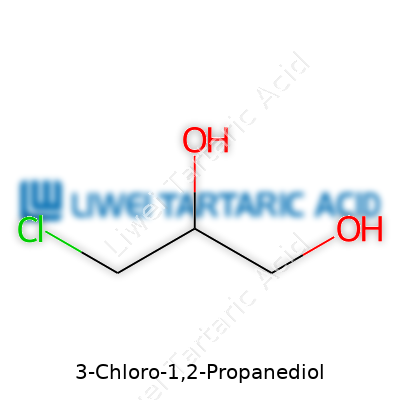
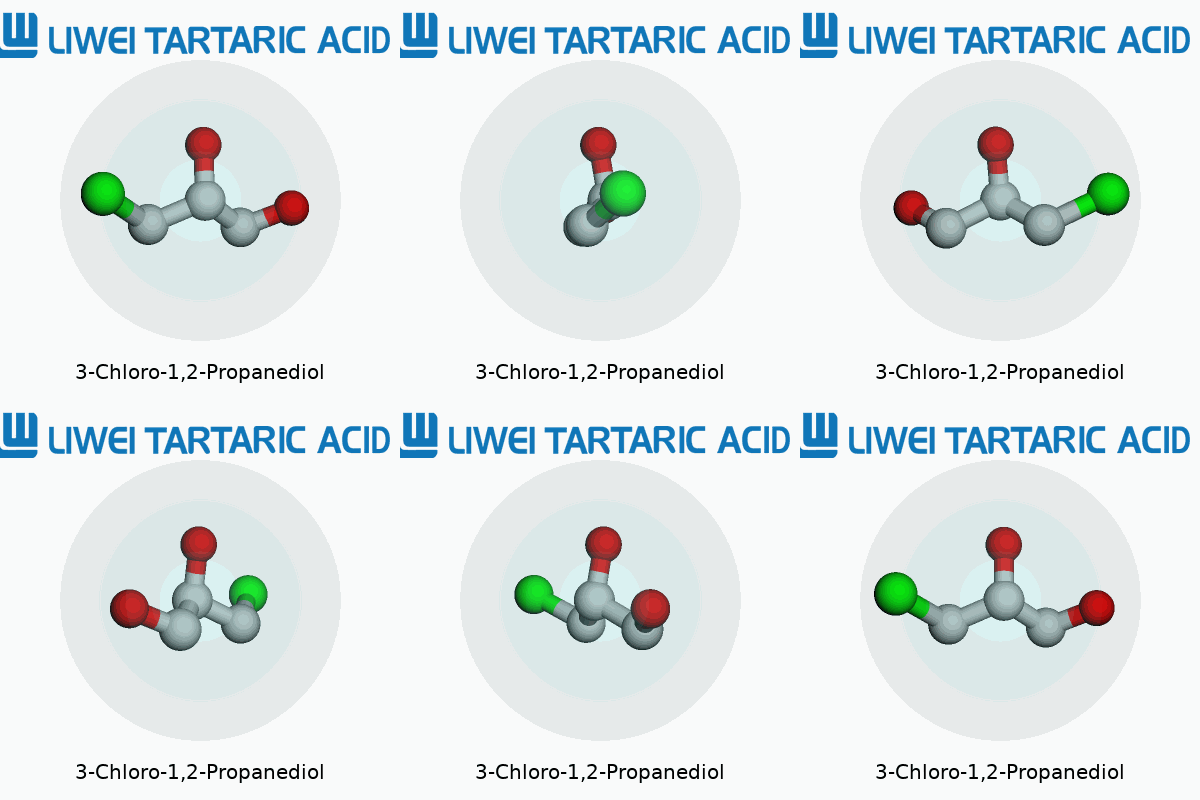
Let’s zoom in on the molecule. The formula reads C3H7ClO2. That means it has three carbon atoms, seven hydrogens, one chlorine, and two oxygens. Picture a propane backbone — three carbons in a row. Attach a chlorine atom to the first carbon. Place hydroxyl (–OH) groups on the first and second carbons, so it sits as a diol. For chem geeks who see it in their heads: ClCH2–CHOH–CH2OH. That’s the chemical skeleton behind the headlines.
3-MCPD crops up in many edible oils when fats meet chloride at high temperatures. Chemistry textbooks focus on bonds and functional groups, but the rest of us care because this small molecule slips into food along the production line. I first heard about it while working in food safety research, in studies testing batches of soy sauce. 3-MCPD likes to hide in anything hydrolyzed with acid, which covers not just sauces but also some margarines and baby food ingredients.
Health agencies, such as the World Health Organization, mark it as a contaminant with potential to cause trouble. Studies in rats have linked high exposure to kidney damage and even cancer. Food inspectors around the globe set strict limits, often less than 0.02 milligrams per kilogram of food. The science isn’t perfect — low-dose impacts on humans still raise all sorts of questions. Still, the goal isn’t just chemical purity. It's trust at breakfast or dinner, knowing what’s in food bought and served.
Controlling 3-MCPD involves both chemistry tricks and big-picture changes throughout the food industry. Manufacturers can lower its presence by changing processing conditions: try lower temperatures, swap out hydrochloric acid, or switch to enzymes for hydrolysis. In countries with robust food safety systems, frequent testing has helped catch high concentrations before things land on store shelves. Smaller producers, especially outside major economies, still struggle — testing equipment isn’t cheap, and awareness isn’t always strong.
Consumers wield power too, even if they rarely hear about this compound. Reading labels won’t tell the whole story, because 3-MCPD doesn’t show up as an ingredient. Transparent companies list how they make their oils or sauces, and those with certifications for food safety management tend to do a better job controlling byproducts like this.
Education matters just as much as detection. Learning about compounds like 3-MCPD changes how people talk to brands and lawmakers. Several advocacy groups now press for clearer labeling and new laws. From where I sit, public science literacy — not just in labs but in kitchens and shops — pushes companies to care about the invisible molecules lurking in our food. Regulators, working with both industry and ordinary eaters, set the boundaries to keep breakfast safe, one molecule at a time.
Not everyone knows the name 3-Chloro-1,2-propanediol (3-MCPD), but plenty of folks have had at least indirect contact with it. Factories use it in manufacturing, workers handle it during routine shifts, and scientists track it because of its toxic reputation. The World Health Organization lists it as a possible carcinogen, and researchers have linked repeated exposure to kidney and reproductive problems. Forget the jargon: a chemical with this sort of track record deserves respect on job sites and in storage.
Spills don’t just stay put. Liquid 3-MCPD can seep into concrete, linger in the air, or reach drains. Once that happens, families down the street, not just those near the factory, face potential exposure. Relying on paper protocols misses the point. Workers remember the sting in their noses long after cleaning up, and some tell stories of headaches or raw skin hours later.
Stopping a spill starts with training, not just instructions on a wall. Gloves, splash goggles, and heavy-duty coveralls do more than tick boxes; this gear cuts real risk. Workers should talk through drills, try equipment, and never treat these exercises as just another safety video. Confidence comes from knowing how to spring into action, not just hoping things will be fine.
Time moves quickly in a spill. Anyone nearby should leave and let only trained responders handle cleanup. Open windows or doors to create a draft, and never underestimate fresh air. Simple fans or exhausts keep vapors from spreading. Pouring water on a spill sounds helpful but can make problems worse, as 3-MCPD dissolves and spreads. Instead, use sand, spill pads, or absorbent clay to soak up pools and sweep them into sealed bins. Regular trash cans won’t work, since disposal laws treat chemical waste much differently.
Direct contact, like a splash to the face, should push anyone to rinse right away with running water, not just a wet paper towel. Medical professionals know skin blisters, sore throats, or dizziness mean fast attention, not toughing it out until the end of a shift. Old habits—like wiping chemical-soaked gloves on uniforms or skipping handwashing—can lead to problems hours later.
Spills rarely affect just one person. Company managers should walk the line between transparency and panic. Quick emergency notices, clear labeling on storage tanks, and regular checks of safety gear are everyday choices that protect more than the factory floor. Neighbors and first responders deserve to know if trucks run through their neighborhoods loaded with 3-MCPD, and city officials should push for up-to-date emergency contacts for every plant.
Not every risk disappears after cleanup. Factories and labs can ask independent inspectors to review handling routines each year. Digital sensors now track airborne toxins in real-time, making it easier to spot and address leaks sooner. Talking about 3-MCPD as a shared concern—rather than a technical nuisance—creates the right sort of pressure. Paying real attention to spills protects health, builds trust, and keeps accidents from repeating.

Providing high-quality chemical products and logistics solutions for global trade partners.



