
In the booming decades of the chemical industry, scientists and engineers kept chasing versatile molecules that could bring value across fields. The development of 2-Ethyl-2-(Hydroxymethyl)-1,3-Propanediol, known in labs as trimethylolpropane or TMP, has a backstory rooted in innovation’s golden age. As industries demanded better paints, plastics, and lubricants, researchers searched for compounds with strong stability and useful reactivity. TMP came out of this pursuit. Its three hydroxyl groups attracted chemists looking to create branched, crosslinked polymers—qualities that have made TMP a basic building block for modern polyurethane and alkyd resins, forever reshaping how coatings and foams get made.
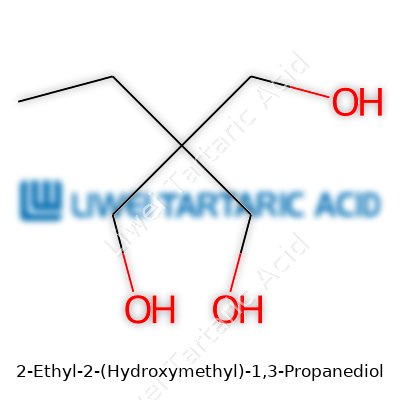
2-Ethyl-2-(Hydroxymethyl)-1,3-Propanediol offers three hydroxyl groups, an ethyl group, and a carbon backbone that shows up in all sorts of polymer chemistry. With its creamy white crystalline form (in most commercial samples), TMP is neither flashy nor rare in the world of industrial chemistry, but it delivers backbone and structure to coatings, adhesives, and lubricants. Phone screens that repel scratches, automotive paints that last through years of sun, snow, and salt—they all owe a nod to this compound.
TMP forms as a solid at room temperature. Its melting point hovers around 57–61°C, which makes it easy to handle in molten or dissolved form at a plant. Odorless, non-volatile, and with a slight sweetness on the tongue (though tasting it goes against safety basics), TMP dissolves well in water and polar organics. Three primary alcohol groups open plenty of doors in reaction schemes, especially for creating esters and ethers that drive polymer crosslinking. Chemistry’s all about options, and TMP’s molecular structure offers a three-pronged attack to synthetic challenges.
Product labels in industrial catalogues mark TMP purity (most often above 98%), moisture levels, solid-state color, and trace metal content. Labs and factories look for low-acid, colorless batches to avoid contamination in sensitive applications. Because its solid form can cake during shipping, packaging demands careful sealing and desiccant use to keep things flowing. Often, labels will list the CAS number, typical batch analysis, and safety precautions for storage and handling, making regulatory compliance far easier for both buyers and end-users.
TMP takes shape through a base-catalyzed condensation involving n-butyraldehyde and formaldehyde. Chemists learned to control reaction temperature, pH, and feed ratios, preventing unwanted side products and getting a clean batch. Scale this up, and it turns into a continuous production process, pulling maximum yield with minimal waste and water use. The advance of continuous flow reactors gave the industry a level-up in efficient, safer, and greener production, reducing manual intervention and human hazards.
With three reactive sites, TMP shines in esterification and etherification. Chemists turn TMP into esters for plasticizer additives or react it with acids to shape alkyd resins (look around next time you handle outdoor metal!). Polyurethane and polyester processes benefit from TMP’s regular branching. On the synthetic front, engineers can tweak TMP’s structure by adding bulky or aromatic groups, letting manufacturers tailor material properties—like adjusting resin flexibility or resistance to yellowing. TMP stands out as a bridge between simple building blocks and next-generation polymers that meet the world’s shifting needs.
You can find TMP under several names: trimethylolpropane, 2-ethyl-2-(hydroxymethyl)-1,3-propanediol, and even its shorter moniker, TMP. Some catalogues list trade names, all leading back to the same core molecule. Such synonyms play a small but real role; they help engineers and procurement staff avoid mix-ups and make ordering straightforward, whether you’re in Hamburg, Shanghai, or Houston.
Working with TMP calls for common sense and respect. Skin and eye contact should always be avoided, and dust inhalation can irritate the respiratory tract if ignored. Proper ventilation, gloves, goggles, and dust control keep the routine safe. Warehouse managers store TMP at moderate temperatures, away from acid or strong oxidizers. Spill protocols focus on solid cleanup and waste neutralization. The global nature of TMP trade means adherence to chemical regulations like REACH in Europe, TSCA in the US, and the GHS for hazard labeling—proving, once again, that organizational commitment protects both people and supply chains.
TMP makes its biggest mark in resin manufacturing, especially in automotive and architectural coatings, high-performance foams, and lubricants. Polyurethane flexible foams bend without breaking, thanks in part to TMP crosslinks. In alkyd paints, TMP improves weather durability and gloss retention, critical for exterior surfaces that see year after year of sun and rain. In industrial lubricants, TMP-derived esters provide cleaner burning and higher viscosity stability, protecting machinery years beyond mineral-oil competitors. Companies dive deeper into TMP for printing inks, adhesives, sealants, and even certain pharmaceutical intermediates, showing how a foundational molecule grows in relevance as end markets diversify.
Chemistry moves quickly, and TMP research stays at the cutting edge of both polymer science and green chemistry. Teams worldwide keep hunting for ways to source TMP from renewable feedstocks to cut reliance on formaldehyde or reduce carbon emissions. Research also threads into designing TMP-based resins that meet stricter environmental regulations—like low-VOC paints or biodegradable plastics. Universities and industries alike explore catalytic processes that demand lower temperatures and use fewer hazardous solvents, expanding the green footprint while cutting manufacturing costs. Patents tell the story, with engineers and scientists constantly finding new crosslinkers, monomers, and formulations based on this familiar triol.
TMP shows low acute toxicity for both human and environmental exposure under normal handling conditions. In animal studies, ingestion led to mild symptoms; TMP’s solid state and mild volatility make the risk far lower compared to low-molecular-weight alcohols. Testing on water and soil ecosystems focuses on persistence and breakdown, with most studies showing quick biodegradation without significant bioaccumulation concerns. Still, as with any chemical, accidental release into the environment needs a managed response, not only to stay compliant with regulations, but protect local water quality and soil health.
If there's one thing TMP’s story teaches, it’s adaptability. As global agendas push for safer chemicals and cleaner processes, TMP stands as one of the established raw materials already seeing significant upgrades. New catalytic pathways using biobased feedstocks look promising, as does the shift to manufacturing processes with lower energy footprints. In polymers, chemists are carving out new uses for TMP in biodegradable plastics, flexible electronics, and smart coatings that respond to light or stress—areas barely imagined when the molecule entered industry decades ago. The push for green chemistry and more responsible sourcing will only deepen TMP’s significance, showing how tried-and-tested molecules can keep finding a place at the frontier of materials science.
Lots of products in everyday life owe their structure and stability to chemicals that work behind the scenes. One that stands out is 2-Ethyl-2-(Hydroxymethyl)-1,3-Propanediol, known to some as TMP for short. The name might sound technical, but its role is pretty straightforward. Manufacturers use it as a building block in materials that need to last, like coatings, plastics, and adhesives—stuff you touch, use, or walk on every day.
If you’ve ever spread paint on a wall or popped open a plastic food container, there’s a chance you’ve held an object relying on TMP. Paint, for example, uses it to become tougher and resist weather and wear. Plastics incorporate it for similar reasons, making car parts, storage bins, and outdoor fixtures more durable. From backyard furniture to office fixtures, polymers made stable by TMP stand up better to sunlight, rough handling, and bending. Once you learn this connection, it’s hard not to appreciate how chemistry shapes even the ordinary parts of a day.
It’s not just paint and plastic. TMP shows up in adhesives and sealants, ensuring floors stay glued and windows hold tight. It even helps some lubricants resist breaking down at high temperatures. Plenty of industries depend on this chemical’s knack for creating strong crosslinks in materials, which means products don’t fall apart or degrade as quickly.
Some folks get nervous about chemicals that turn up in household products. That’s fair. TMP has a reputation for low toxicity, but it’s smart to give it proper respect. Factories and labs use gloves and ventilation when handling it, so long-term exposure stays low. Regulatory bodies monitor the use of industrial chemicals like TMP, especially in large-scale production, to ensure safe manufacturing and disposal practices. This oversight helps protect both workers and neighborhoods near manufacturing sites.
As someone who’s spent years working around chemicals in manufacturing, I notice people trust safety when they know regulators really watch out for the details and require companies to report how much they use and release. TMP’s record so far stays pretty clean, with no major red flags on human safety or environmental persistence, according to the European Chemicals Agency and other regulatory agencies. The responsible use of TMP means workers get training and factories use filters or physical barriers so this compound doesn’t end up outside the plant or in people’s homes in unsafe ways.
There’s always motivation to improve. Even low-toxicity chemicals can cause problems if dumped without care, so companies and regulators look for ways to use less risky alternatives over time. Research universities and private companies keep pushing to find compounds that break down faster in the environment or that come from renewable feedstocks instead of petroleum. TMP’s balance of performance, availability, and moderate safety still makes it a go-to material in many sectors, but the push toward greener, safer chemistry continues.
Understanding these behind-the-scenes ingredients helps people look at the stuff in a garage, kitchen, or office and ask not just, “Does it work?” but, “Does it work safely and sustainably?” TMP sets an example of how small molecules do big jobs, and how thoughtful innovation and oversight give us safer, longer-lasting products over time.
I’ve spent time in labs where you pick up a bottle, read its label, and run through a mental checklist. Touch or not? Mask or not? “2-Ethyl-2-(Hydroxymethyl)-1,3-Propanediol” — try saying that three times quickly — goes by the nickname “TMP” in a lot of chemical catalogs. It shows up in all kinds of places: resins, coatings, adhesives, even cosmetics. Students and seasoned chemists see it in routines and experiments year-round.
People often ask whether TMP or similar lab chemicals are something to worry about. Here’s what matters. On its own, TMP comes as a crystalline white solid. It doesn’t jump off the shelf, attack your skin, or produce clouds of noxious fumes. Even so, respect is key. According to safety data collected by manufacturers like Sigma-Aldrich and chemical safety authorities, TMP may cause mild skin and eye irritation. Swallowing large amounts can upset your stomach, but that’s hardly a real risk in most settings.
You will find stories floating around online about handling accidents. In real life, wearing gloves and safety glasses has served me and colleagues just fine every time we worked with TMP. I’ve never seen a serious injury related to TMP, but a friend did mention burning eyes after rubbing them before washing up. As silly as it sounds, rushing from mixing to lunch without hitting the sink can trip up even the most experienced.
Authorities like the European Chemicals Agency and U.S. OSHA consider TMP a substance of low acute toxicity. They list proper lab procedures and regular hygiene as sufficient precaution. No warnings about cancer, no suspicion of lasting reproductive harm. That lines up with my own reading and discussions with occupational health experts. The usual advice: avoid breathing dust, avoid direct contact, and keep good air flow in the workspace. Companies set exposure limits for many chemicals, but TMP does not carry strict enforced thresholds like more notorious lab substances.
I believe it’s smart to treat every chemical with respect until you know its quirks. TMP doesn’t demand lab coats that cost as much as a used car. It won’t melt through your gloves or fill your lungs with poison in one sniff. Still, I don’t leave it uncapped or handle it without gloves just because it’s “low toxicity.” Respect becomes a habit over time — one that saves you from nearly every mishap.
Poor housekeeping seems to be the main trouble spot. A cluttered bench, old spills, or a forgotten open bottle can cause surprises, not the compound itself. I learned to sweep up crystal dust, close bottles after each use, and keep TMP in dry storage. People in other industries, like paint or plastics, often use TMP on routines far larger than in the lab, and they share much the same advice. Sensible hygiene, PPE, clear labeling, and employee training produce safer workplaces and fewer close calls.
TMP will stick around in labs and workshops because it works. Its quirks are manageable with common sense, grounded training, and regular attention to the basics. As new workers enter the field, a steady hand and consistent procedures will matter more than memorizing scary-sounding chemical names. Hands-on safety beats anxiety or overconfidence every time.
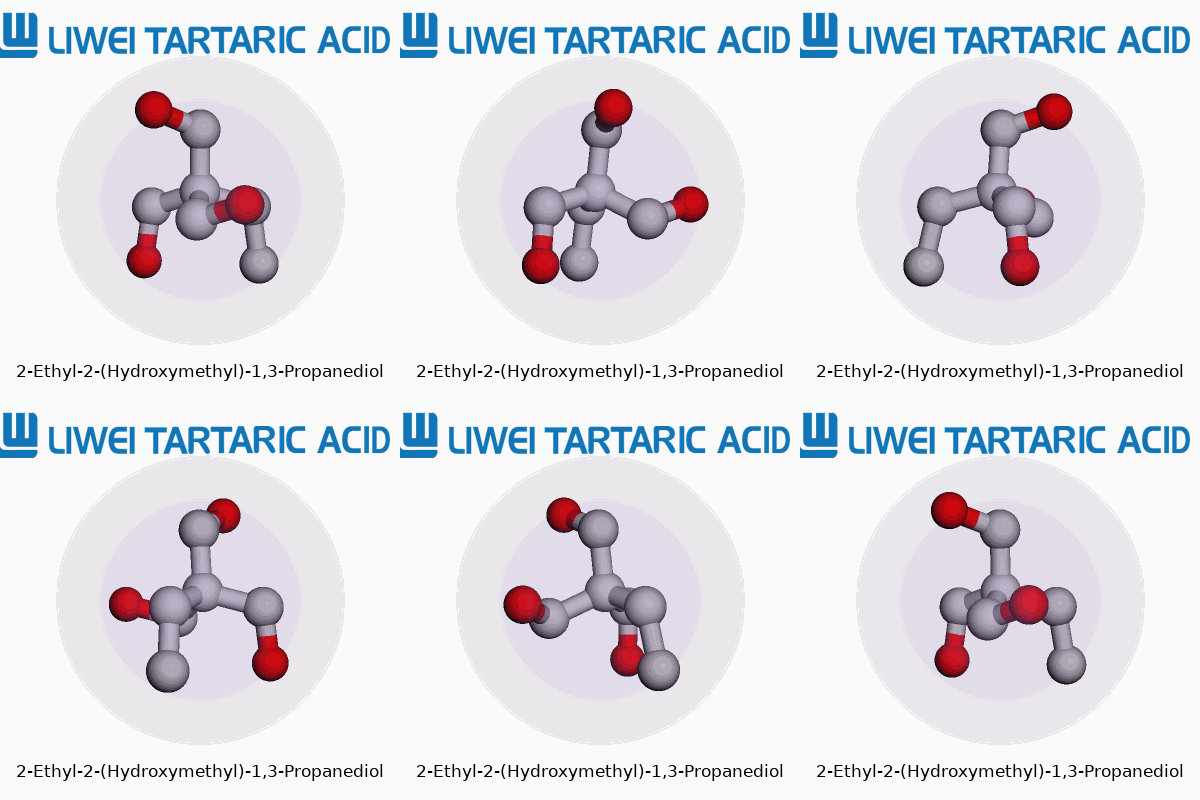
2-Ethyl-2-(hydroxymethyl)-1,3-propanediol, known among chemists as “trimethylolpropane,” goes by the tidy formula C6H14O3. This quirky molecule often shows up in the real world because of its knack for versatility. Its core—a three-carbon propane backbone—wears three alcohol (-OH) groups and a single ethyl branch. Everything in that structure starts to matter once someone uses it outside the lab.
Anyone who has stumbled across tough, clear coatings or fiddled with glossy modern paints has probably brushed against what C6H14O3 brings to the table. Trimethylolpropane helps pour the foundation for alkyd resins and polyurethane foams. It stands out by keeping molecular chains flexible, but not floppy, thanks to those three alcohol groups holding stronger bonds. The structure encourages cross-linking, which means longer-lasting finishes on wood floors, furniture, or even automotive parts.
Basic chemistry class tells us that each atom counts. C6H14O3 means every molecule carries six carbon, fourteen hydrogen, and three oxygen atoms. The placement makes a world of difference. With three -OH groups spread out, the molecule acts a little like a minuscule three-pronged anchor. Each prong gets involved in chemical reactions, making it a building block for other products rather than just a bystander. Families of resins owe their toughness and durability to how these alcohol groups connect with other chemicals during manufacturing.
Most people outside labs never think about what’s swirling in that paint that dries fast and sticks hard. Manufacturers pay special attention to the safety of trimethylolpropane. I’ve seen workers using protective gear since getting even a small amount on the skin brings mild irritation. In factories, keeping the air clean and using gloves becomes basic protocol: not because the chemical is villainous, but because responsible handling matters. In finished products, C6H14O3 doesn’t hang around unreacted, which cuts down exposure risks for regular users.
People worry about chemicals leaking into the water or soil. With C6H14O3, the risks shift depending on how it leaves the factory. Wastewater treatment, safe shipping, and controlled disposal block most of the usual trouble spots. If more companies adopt greener practices—using less solvent, recycling water, monitoring runoff—people and wildlife benefit, even if the process costs a little more upfront.
Chemistry never stops evolving. Research keeps pushing for alternatives that hold up without harmful side effects. Bio-based chemicals show promise. Process tweaks can cut waste. Engineers tinker with formula tweaks that reduce residues. These ideas make a difference down the line—safer products, less pollution, and less worry for families and workers.
C6H14O3 packs three alcohol groups, six carbon atoms, and an extra ethyl branch into a design demanded by builders, manufacturers, and artists alike. The big lesson is that we each have a stake, and a responsibility, in making sure what starts in the lab ends up in our homes and workplaces safe, responsible, and just a little bit better than before.
If nobody’s ever knocked over a container of lab chemicals and spent the rest of the afternoon mopping up a sticky mess, count yourself lucky. 2-Ethyl-2-(Hydroxymethyl)-1,3-Propanediol, better known as trimethylolpropane or just TMP, pops up all over in the coatings, plastics, and resin world. Not because it sounds fancy, but because it helps hold things together. Folks rely on it to keep paints smooth and foams stable. Like a lot of substances that do important work behind the scenes, TMP doesn’t shout for attention. Still, its storage setup deserves a hard look — one missed step can cause headaches nobody wants.
Some chemicals barely care where you put them. TMP isn’t one of those. This compound starts to sweat if temperatures climb or if the air in the room stays muggy. Warm, damp conditions let it suck water out of the air, cake up, and break down faster. So, a tight-sealed container sitting in a spot that stays below 30°C works best. Air-conditioned storage rooms or insulated storage corners do the job for folks in warm climates. Basic warehouse fans might help for milder weather, too. Most manufacturers keep to these temperature and humidity limits exactly because small leaks and spoilage cost both time and money.
Every open lid makes trouble more likely. TMP comes in strong drums or jugs for a reason: oxygen can take a good batch and ruin it. Some chemists have seen whole shipments take on a yellow tint, turn thicker, or even start giving off an odd smell just from a few days exposed to air. If you can, use containers with gasketed seals — skip the plastic wrap, since it can’t block moisture or air for long. And while TMP won’t explode in sunlight, direct rays can push temperatures up and speed up breakdown. Keep everything in a shadowy spot away from windows or just pull a tarp over your storage.
Anybody storing TMP near oxidizing agents, strong acids, or bases runs real risks. These chemicals turn TMP into new compounds, sometimes ones that clog valves or leave dangerous goo. Shared chemical rooms make accidents easier, and I’ve heard enough stories about someone storing bleach and TMP side by side to know it’s not rare. Simple shelving choices help avoid this: separate TMP from anything that sounds like bleach, nitric acid, or peroxide. Mark shelves and make the rule clear for staff or lab students.
Clear dating and labeling help more than most people think. Print the received date in big letters. Pull older containers forward — don’t hide them at the back. Unlike wine, chemicals do not get better with age. Consistently rotating stock lets you use up drums before shelf life becomes an issue. The Chemical Safety Board and OSHA both stress training as the best solution. Staff who know what goes where make honest mistakes less likely.
Instead of improvising, ask suppliers about shipping in smaller units. Bulk containers often lead to leftovers, which are harder to store tightly sealed. Investing in dedicated, climate-controlled cabinets might feel pricey, but costs drop compared to lost product or emergency cleanup. Joining industry forums or local safety workshops brings in practical tips, way beyond what dry regulations cover. The more open the dialogue about storing TMP, the less likely you’ll clean up after an avoidable spill.
Walking through a shop filled with paints, plastics, or even cosmetics, most people won’t stop to think about the chemicals working behind the scenes. One such chemical, 2-Ethyl-2-(Hydroxymethyl)-1,3-Propanediol—more commonly known as Trimethylolpropane—often acts as a building block in these products. Working in a lab in my college days, I noticed safety sheets sitting next to even the tamest-looking chemicals. More than once, that safety paperwork kept someone from learning the hard way that a bit of spillage or inhalation can bring trouble.
Let’s talk openly about what direct contact can bring. When handling Trimethylolpropane, skin and eyes get the short end of the stick. Touching it—or worse, getting dust in your eyes—can bring irritation, redness, and discomfort. Accidental inhalation of dust sometimes leads to coughing and throat irritation. Trying to clean up a spill without gloves can result in dry, cracked hands a few hours later. While large-scale, sudden poisoning isn't likely in casual settings, anyone working with the raw stuff quickly learns why gloves and goggles aren’t optional.
Looking at animal studies, even moderate exposure over time causes issues. Overexposure brings about respiratory irritation in lab animals. Swallowing this compound, intentional or not, brings nausea and digestive upset. Its low volatility makes it less risky for inhalation than, say, formaldehyde or acetone, but the powder form still creates opportunity for exposure during processing.
Trickier issues appear over years, not days. Consistent, unprotected exposure is a recipe for chronic skin irritation. There’s not much evidence that this compound is a major cancer risk or reproductive hazard, but research in this area doesn’t cover everything yet. Given enough time, any chemical that irritates or dries skin can start to cause dermatitis.
In production facilities, air monitoring matters. Workers rightly expect a safe environment, and nobody wants to take home traces on their clothes or shoes. Environmental risks, by contrast, seem lower; this compound breaks down in the environment, and large spills don’t build up in soil or water the way oil or heavy metals do.
Most safety incidents stem from skipping basic protection steps. Companies do well to keep eye-wash stations in reach and encourage use of gloves or face masks. Good ventilation clears out airborne dust. Written safety guidelines, alongside regular staff training, do more than any posted warning sign. Labs should keep this chemical sealed in containers and off open benches. In my own routine, washing up before grabbing a coffee mattered as much as donning gloves in the first place.
Waste should go into clearly labeled containers, then handled under guidelines set for local disposal—not poured down a sink or tossed with regular trash. Local rules sometimes look strict on paper, but keeping up reduces downstream headaches for everyone. Sharing incident stories and encouraging colleagues to report near-misses can boost group vigilance and turn the workplace into a safer space.
Trimethylolpropane supports industries that touch daily life, but even a workhorse like this deserves healthy respect. Whether in a manufacturing plant or a university lab, practical safety habits, clear policies, and ongoing education make a difference. Reasonable caution stops a minor chemical from becoming a major problem.

Providing high-quality chemical products and logistics solutions for global trade partners.



